Structural Color Part I: Liminal Buntings
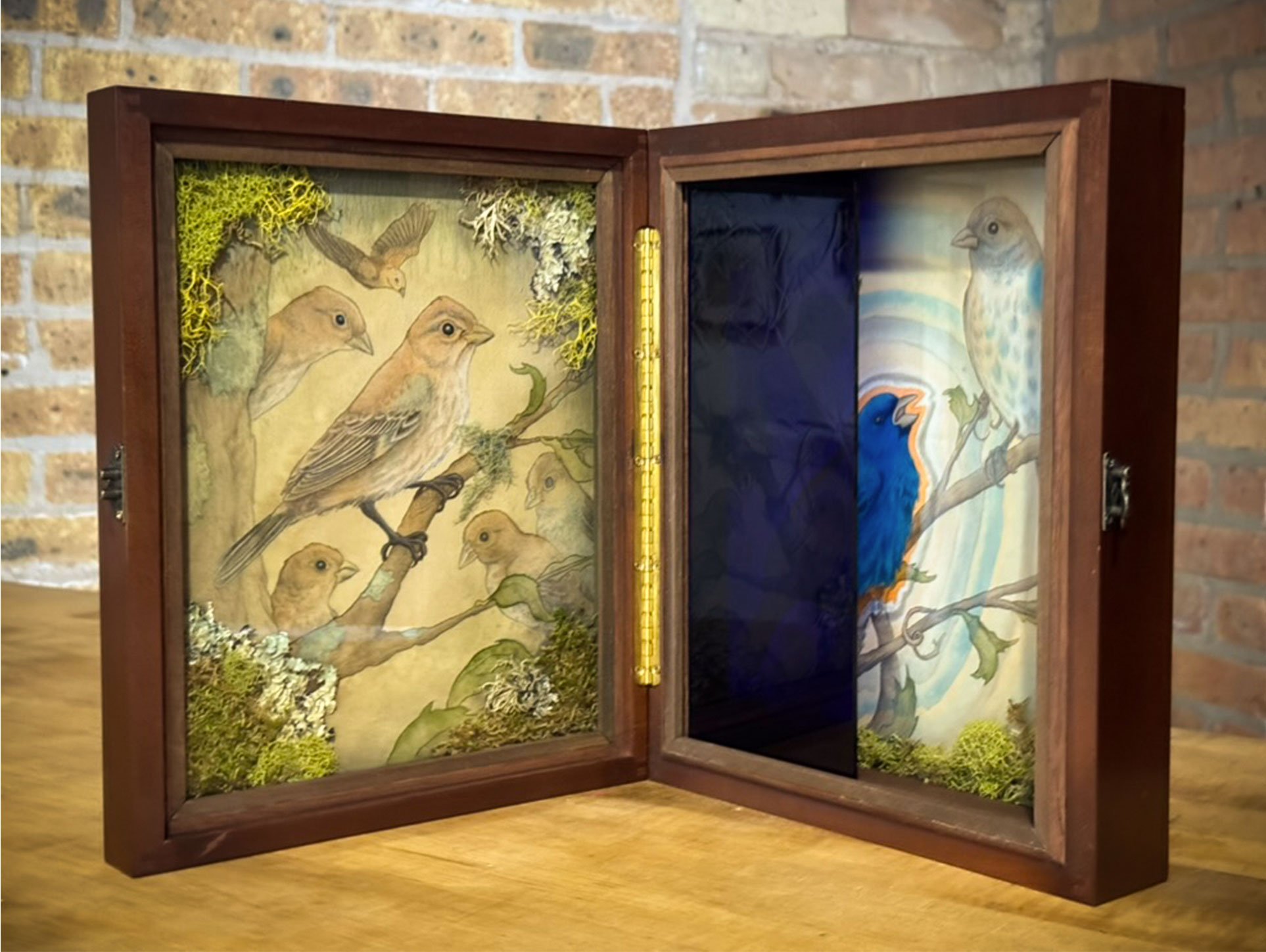
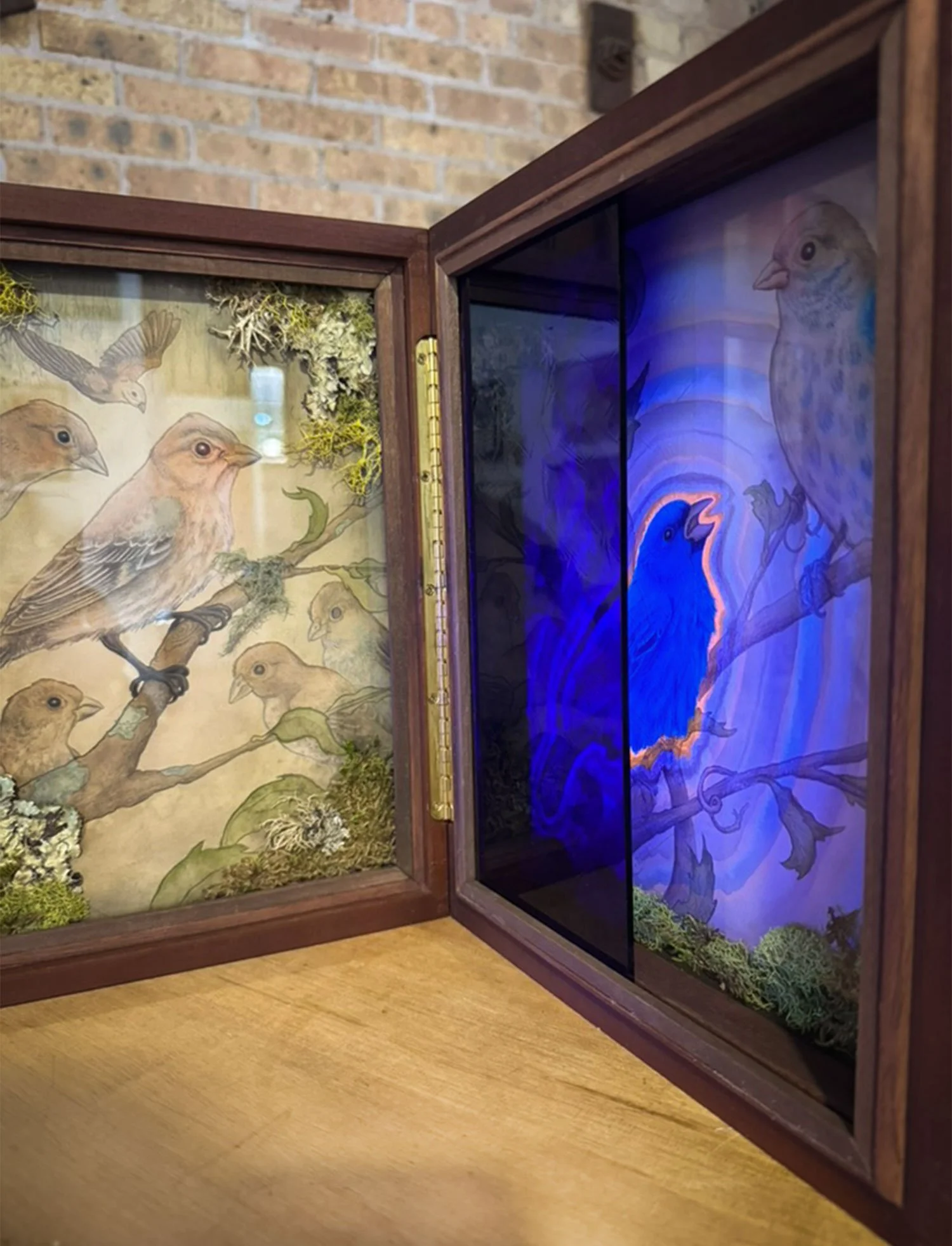
“Structural Color: Liminal Buntings”, mixed media assemblage, Ven Loetz 2026
The environment of my childhood in a 1980’s suburb was the stuff of family sitcoms; modestly sized mowed lots, winding roads with concrete curbs and sidewalks. There were little neighborhood parks each with its own basketball court and old-school playground, the kind with play equipment made from metal pipes with long metal slides that burned your legs in the heat of summer and chilled you to the bone the rest of the year. I climbed jungle gyms made from old tires and scraped my knees crawling through sections of concrete tubes.
For the most part, “nature” seemed like something that existed in library books, PBS documentaries, and the rare field trip to a museum. The nature found in my yard was comparatively sparse and sanitized, but nonetheless mysterious. Green apples fell from the trees each fall and rotted in the grass while chipmunks dug tunnel systems under the patio; I eagerly pried up concrete pavers to reveal intricate ant colonies beneath. There was nothing quite like crisp air, the scent of fallen leaves, or the excitement of finding a bulky neon green caterpillar that would one day become a butterfly or an enormous moth.
But the things that most caught my attention were harder to catch in the wild. I was obsessed with birds. My parents and grandparents on both sides of my family had a love of birds and bird identification and I’d picked up on their fascination in early childhood. Using their pocket guidebooks as reference, feather by feather, I carefully rendered each species in crayon. The birds’ scaley legs and clawed feet took on vivid detail and disproportionate size. I wondered how something so soft and colorful could also have “scary” reptilian parts.
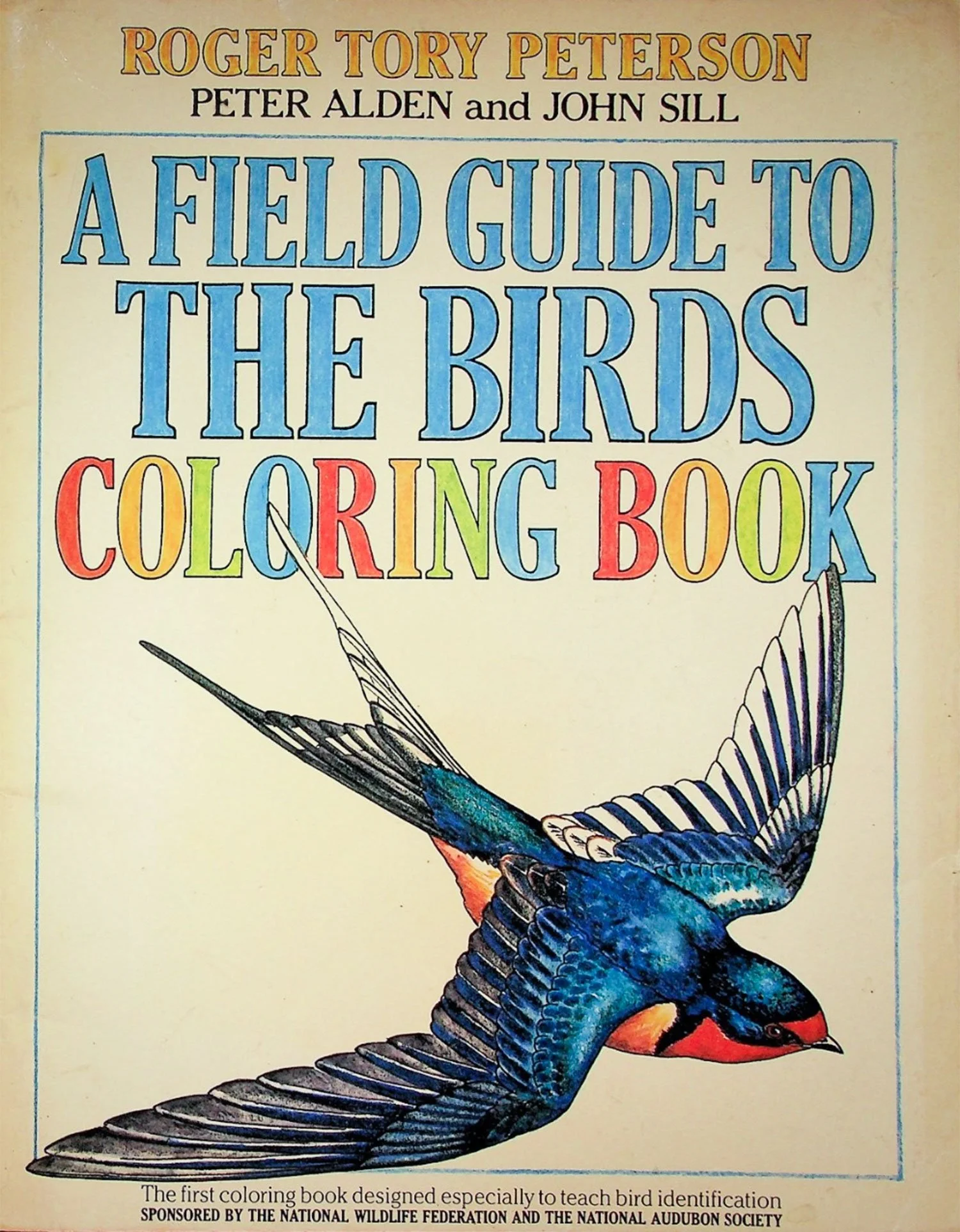
My childhood bird coloring book circa 1982
Noticing my interest, my father gave me a “Birds of North America” coloring book and colored pencils. I matched each bird with its pencil; red for cardinals, yellow for goldfinches, and blue for indigo buntings. Our backyard birds, however, were mostly a pallet of tan, brown, black, and grey. I colored them in the coloring book too; grackles, sparrows, robins, and mourning doves.
Still, the strangeness of their scaley legs hooked my curiosity. The unbelievable softness of feathers contrasted the sharpness of beaks and claws. The elusive lightness of flight made the real birds a darting blur at the peripheral of my childhood attention span while the coloring book and crayon drawings made them solid and tangible. Who were these creatures and how could I have a relationship with something so fleeting?
A weekend trip to the Milwaukee Public Museum brought me up close and personal with taxidermy birds; the real thing, but dead and glassy-eyed. The museum also introduced me to the world of dinosaurs. The massive, scaley legs of the T-rex towered over me in a life-sized diorama. Giant claws anchored the monster over its prey; a horned triceratops, helplessly eviscerated in the mud.
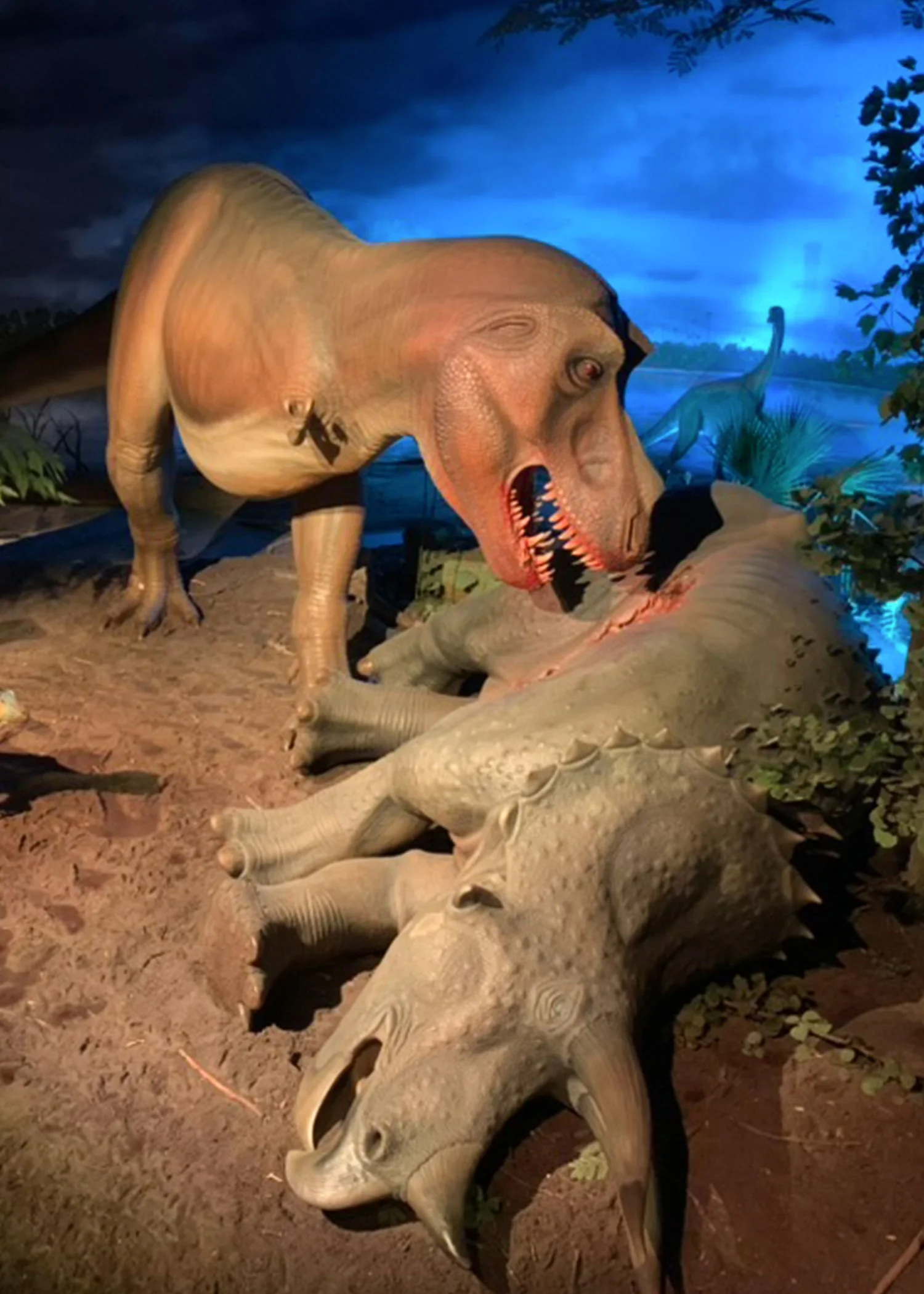
Milwaukee Public Museum’s Hell Creek diorama, opened to the public in 1983 and will close at the end of 2026
Learning that dinosaurs were the ancestors of birds opened many mental doors. It connected the threads of those reptilian legs and claws to their monstrous heritage. This was my first introduction to the concept of evolution and the depth of geologic time. A dinosaur coloring book was purchased in the giftshop, and those twin interests of birds and dinosaurs have been with me ever since.
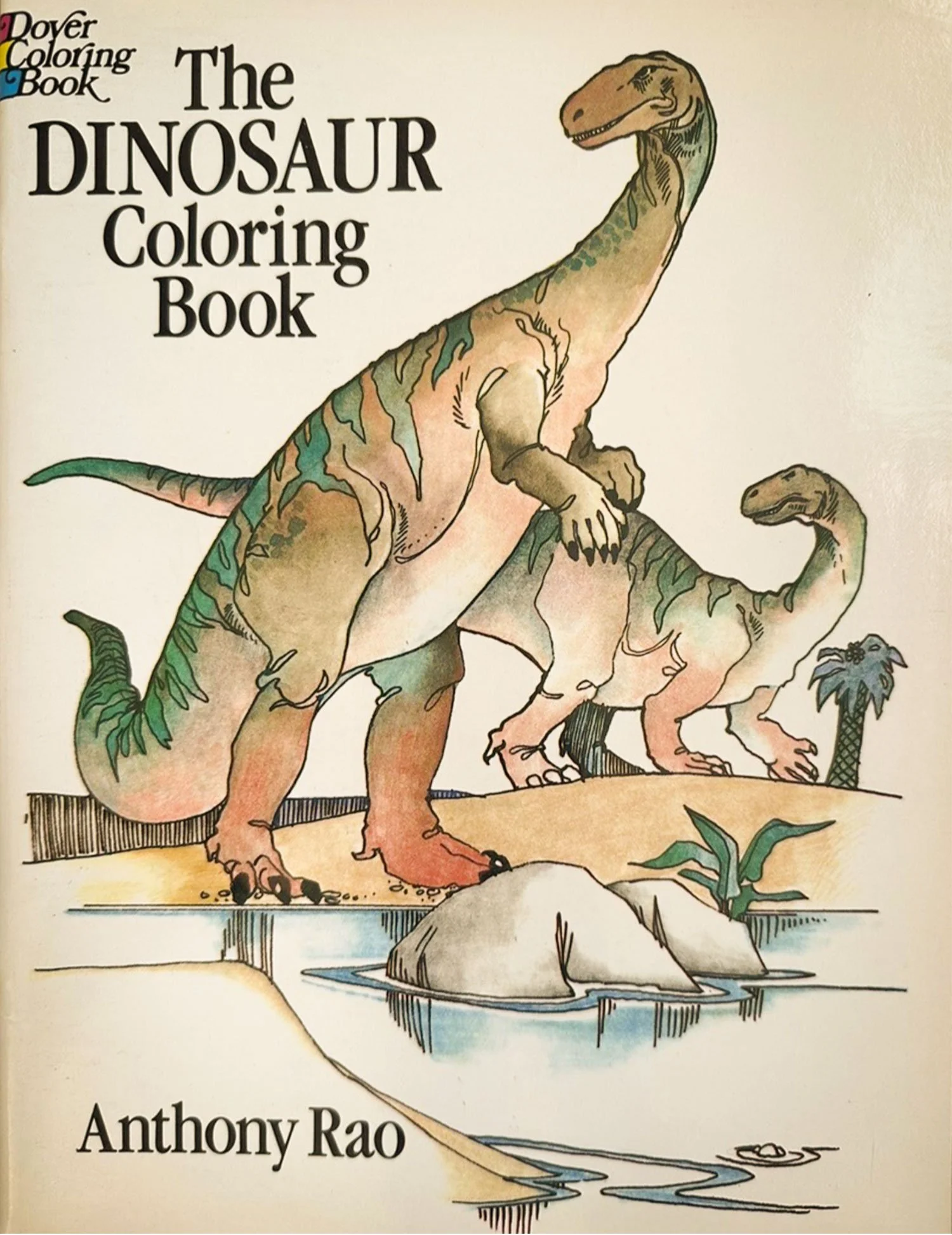
Cover of my childhood dinosaur coloring book
Much like our backyard failed to produce a rainbow of birds, the rocks in our area failed to produce any dinosaur fossils. They were mostly Silurian and Devonian and it would take time and maturity for me to develop an appreciation for their antiquity. Instead, I delved eagerly into stacks of library books, VHS tapes, and continued to return to my colored pencils, absorbing and reproducing birds and dinosaurs in intricate detail. I drifted to other natural subject matter at times but always came back to the birds and dinosaurs.
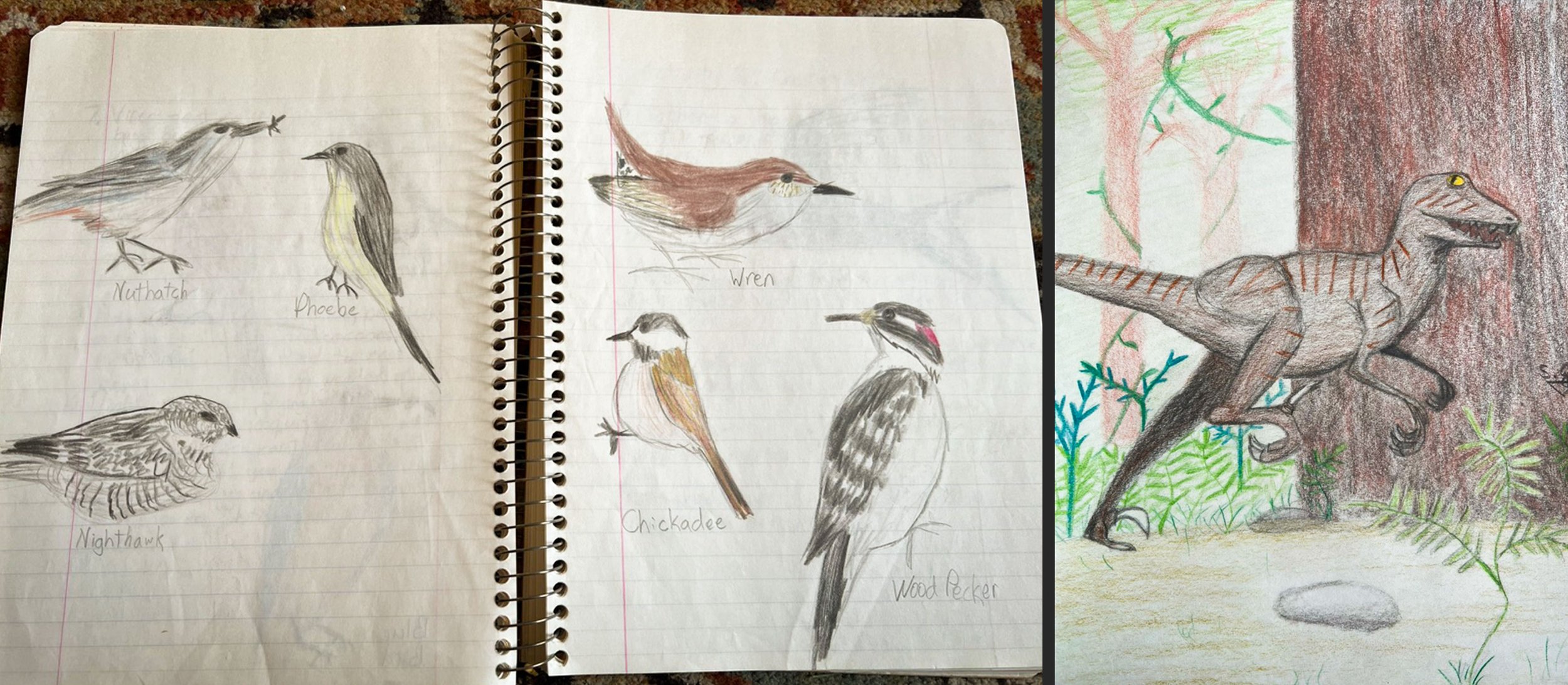
drawings from my sketch journals, 1992-93 school year.
In an eighth-grade science class, we were assigned to choose one native bird species to do a project about. Looking through my old coloring book, I decided my favorite was the bright blue Indigo Bunting. The internet was in its infancy, so I did what we did back then; I walked to the town’s library and checked out a book with a cassette tape. I read the single paragraph of information and drew a colored pencil portrait of the indigo bunting freehand as a visual aid for the assignment.
Then I decided to learn its song; I sat with my Radioshack tape player, rewinding the cassette over and over. A man’s voice would announce “Indigo Bunting” followed by a short, complex series of lilting tweets.
Rewind.
“Indigo Bunting.”
The song again.
Rewind.
“Indigo Bunting.”
But no matter how many times I listened, I couldn’t consciously hold the song in my mind. As soon as the recording ended, the notes slipped away.
When presenting the project in class, I stated that I’d picked the indigo bunting because it was my favorite bird. But internally, I felt like a fraud because I’d never actually seen one in real life. I only knew it from the pages of a coloring book and field guides. I couldn’t even remember the song to know if I’d heard one.
A few years later, my family moved less than a mile away into a house on a river, a migration path. It was hard to believe this rugged cul-de-sac had been tucked just outside of my awareness for my entire childhood. Here the sidewalks and curbs gave way to gravel shoulders and houses with wells and septic tanks. My parents put up a birdfeeder and suddenly the pallet of my real-life bird sitings exploded into a Crayola rainbow.
One spring morning while getting ready for school, I heard a bird song that sounded vaguely familiar. I couldn’t quite place it. I looked out the back window at the bird feeder and saw it; the cassette tape voice chimed inside my head “Indigo Bunting”.
Since that first siting, the indigo bunting has appeared to me infrequently, but always like a call back to childhood. While I still can’t consciously bring its song to the forefront of my mind, I still know it when I hear it; a repeated voice from a cassette tape, a bright blue from the pencil box.
The indigo bunting has called to me twice this past summer in two different locations. It called like a fluttering memory; a small, startling blue thread tying disparate parts of my life together.
Out of curiosity, I needed to know: what gives the bird it’s signature blue color and how does it know its song? Like most things, the closer you look, the more interesting and surprising it becomes.
The indigo bunting (Passerine cyanea) as a species is named for the vivid blue color of adult breeding males; females are a mottled tan color and are indistinguishable from juvenile males. During spring migration, mature males molt and the new feathers that come in are bright blue-turquoise-indigo. Their entire body is this vibrant monochrome during the height of breeding season, with some black detailing in the wings and tail. Then they begin to molt again during the fall migration. The feathers that come in are mottled tan (like the females) with only a few turquoise splotches remaining by the time they reach their wintering grounds (Hudson & Wilcoxen, 2018; Rohwer, 1986). Thus, the entire species is named after what the mature males look like for a fraction of their lives. I can only imagine how this might seem (if birds can understand such things) to the females.
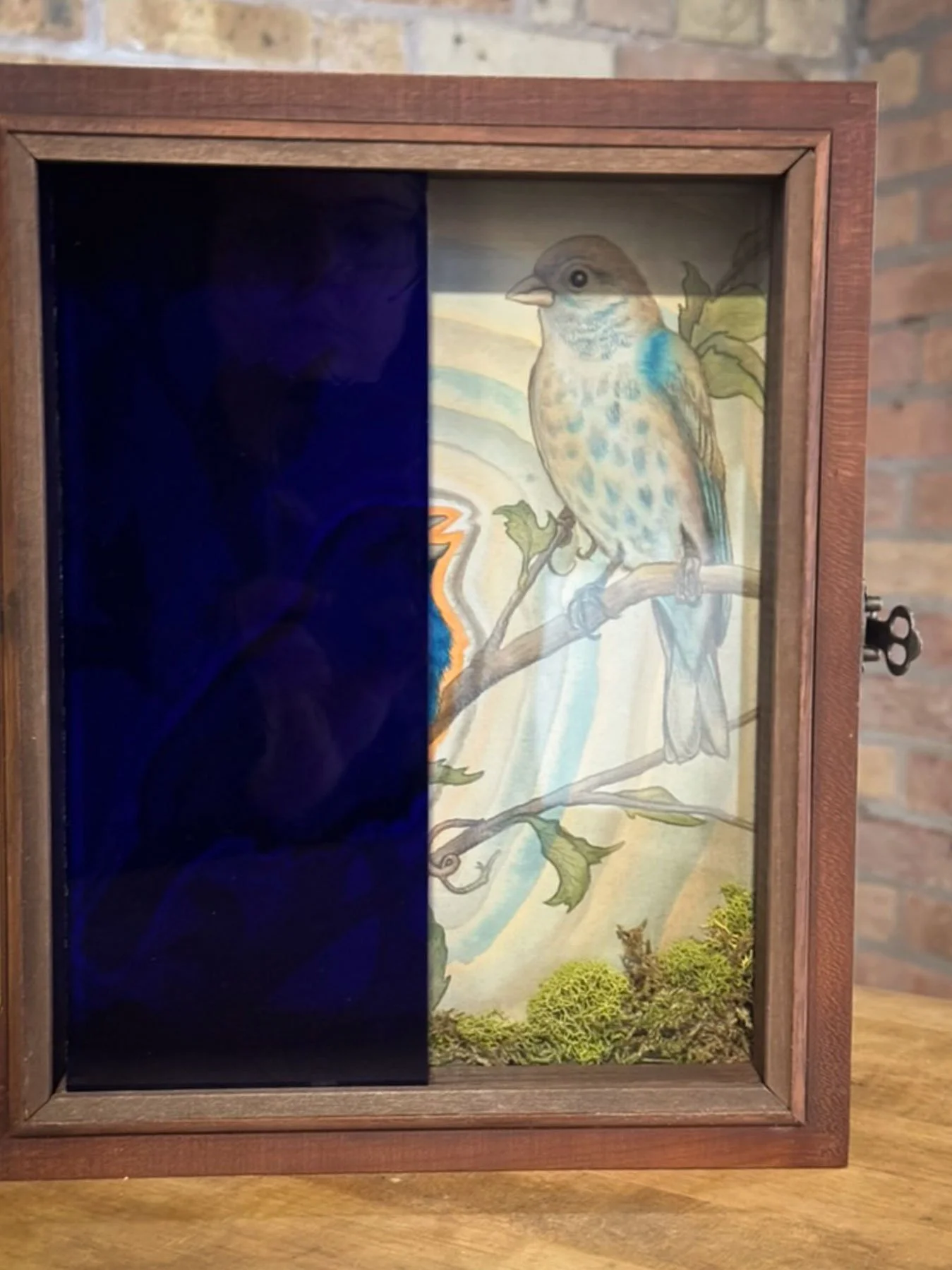
“Structural Color: Liminal Buntings” (detail), mixed media assemblage, Ven Loetz 2026
To complicate matters further, the blue color is not a pigment but an example of something called “structural color”. The blue appearance is the result of a random, microscopic pattern of keratin and air bubbles inside the feather. The pattern scatters the light that bounces off it, giving flashes of blue-turquoise-indigo. The color and its vibrancy are dependent on the strength and direction of light hitting it. When backlit, one of these shed feathers looks dull brownish black (Hudson & Wilcoxen, 2018). Additionally, birds see further into the UV end of the spectrum than humans do, so how the birds see each other is different from how we see them.
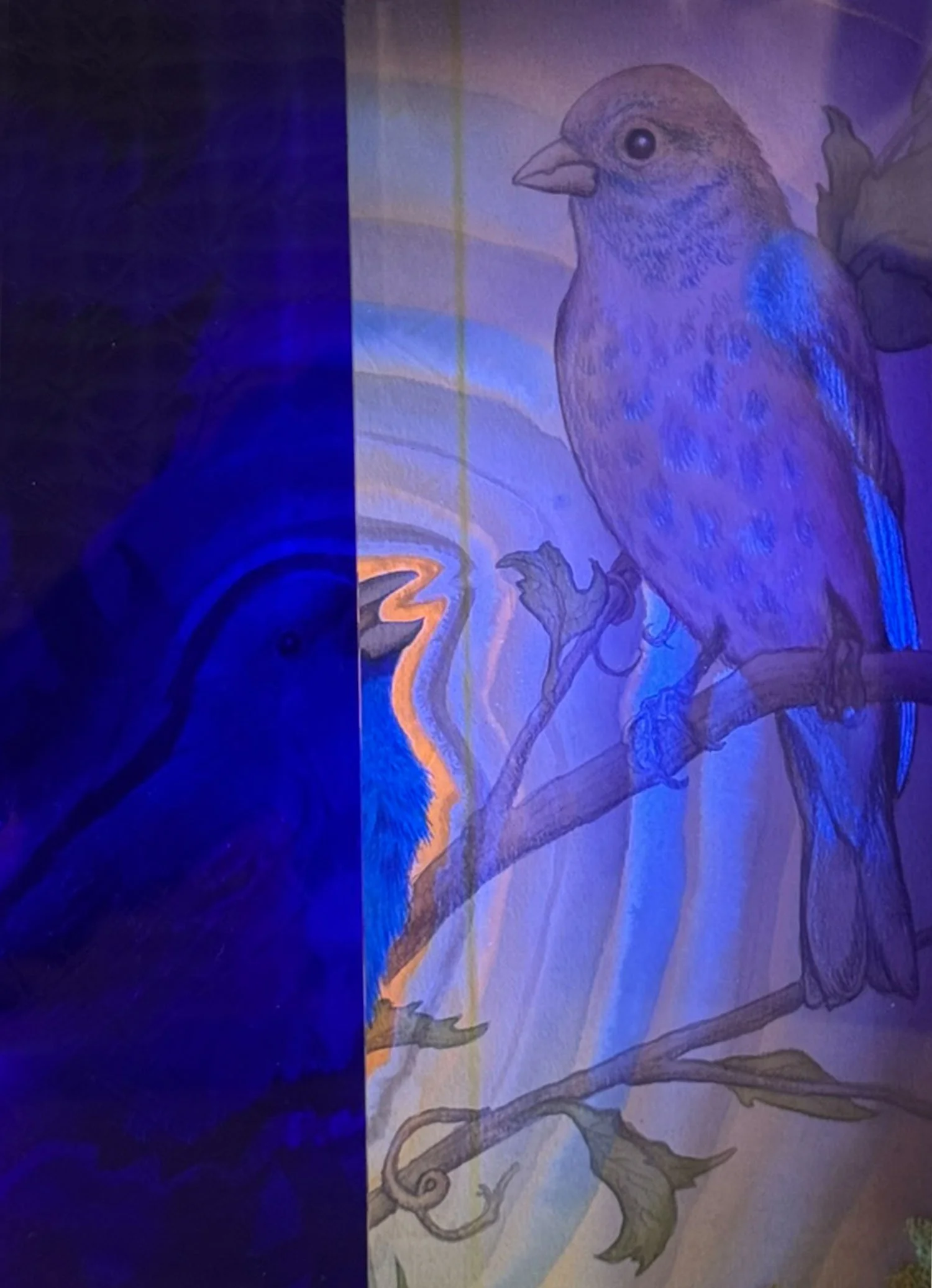
“Structural Color: Liminal Buntings” (Detail), with UV light, Ven Loetz 2026
The indigo bunting’s color is entirely dependent on context; age, sex, time of year, point in migration, angle and strength of the light hitting it, and who’s doing the observing. All these factors are a response to environmental need and species level goals. When the birds are young, their primary objective is to not get eaten by predators while they grow and develop. During adulthood, the male’s priorities shift seasonally. During summer, their primary goal is to be seen, to be heard, to be recognized. They flash their feathers in the sun and belt out a complex song to attract attention. The idea is to be loud, bold, special, extraordinary.
The females, in contrast, do not sing. One could say the female’s priority during this time is to blend in for safety; to be quietly generative in the shrubs. However, they are not so passive as they seem; the females regularly cross in and out of their established breeding territories to form relationships with the neighbors, gather social intel, and scope out foraging resources (Carter et al., 2018). And the males did not become showy on their own. They were colored in blue by generations upon generations of female choice and consent. Like 97% of all bird species, indigo buntings lack penises. If you’re going to fly, you can’t be dragging around a bunch of extra weight, so if it’s not needed, why keep it? The buntings mate in a mutual act called a “cloacal kiss”. The females aren’t as passive as they look; they are collectively the artists of the males. They color them in and shape the male’s song via their attention and discernment.
Birds are not born knowing their song. It’s passed down generationally through social learning from mature males to the young. The birds start out, much like humans, babbling and cheeping incomprehensibly. It takes them time, careful listening, a lot of mistakes and corrections to hone their craft (Beecher & Akcay, 2021). Also, like humans, they have subtly different local dialects. Breeding males utilize their dialect not only to attract mates, but to define their territorial boundaries. Their individual song acts as both an attractant and a deterrent depending on who’s listening.
During migration, everyone’s priority is to transition from one mode of existence to another. Like a fading blue thread, they tie two regions together, traveling across ecosystems, across borders. No longer defending a territory, they move together at night as a flock. They can even carry some passengers such as snails (Zenzal et al., 2017). By the time they reach their wintering grounds, everyone is mottled and drab. Everyone’s priorities are survival, bonding as a social group, finding and sharing food resources.
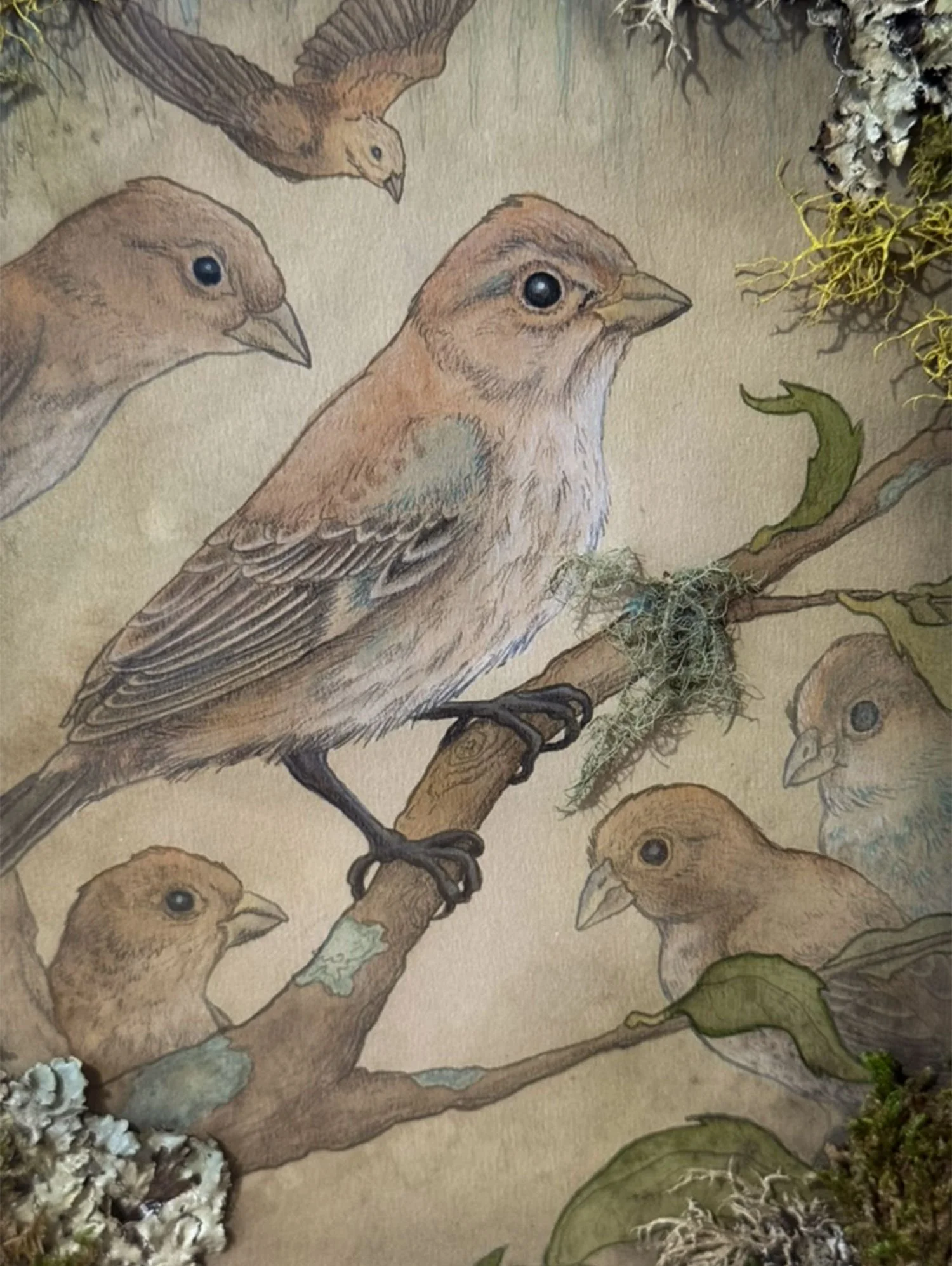
“Structural Color: Liminal Buntings” (Detail), Ven Loetz 2026
The males spend the bulk of their existence in a queer half-male-half-female coloration that is neither showy nor entirely drab; a space between gendered expressions.
The question remaining is, why the yearly migration? Why not stay where it’s warm year-round? Why the elaborate song and dance in the north and the quiet blending in down south?
Building and maintaining the extra internal feather structures of mating plumage is energetically costly and can take valuable resources away from immune function, sustained flight, and foraging. Scientists studying hormone levels in birds have found that testosterone (for example) does not stay at a steady baseline in male birds. It elevates when needed for defense, establishing territory, and mating and then wanes when it’s not needed. Staying at an elevated level is actually unhealthy and can interfere with social relationships and rearing young (Martin & Ghalambor, 2026; Smith et al., 2005). In this way, hormones and breeding plumage are biological tools that can be produced for specific jobs and dialed down when not needed. There is a season for being an extraordinary individual, a season for standing your ground and aggressively defending your territory. But to be indefinitely in that state of individualistic hypervigilance would be physically and psychologically exhausting and detrimental to the population as a whole. So there is also a season to let your guard down, to blend in with the flock and share resources, to build and mend ties. And to have these two seasons, there must also be a journey between them, a transition from one mode of being to another. There’s a philosophy for every season and an oscillation that keeps them balanced. From blue to tan and back again.
I didn’t even know any of this when I awkwardly stood in front of my science class as a 13-year-old, an immature example of my species, my plumage a combination of K-Mart knockoffs, home-sewn, and hand-me-downs from older cousins. If I could sing back to myself during that time, I’d tell myself that I’m not a fraud for not having met my favorite bird yet. I’d tell myself I’ll hear that song again and each time I’ll know it a little better.
Each time the indigo bunting calls, it calls me a little closer. It calls me home to myself as a strange bird in transit. A bird that’s colorful, extraordinary, and territorial at times and quietly generative when that’s what’s called for; but most of the time, a bird that lives in the spaces between; a fading blue thread connecting worlds. A hidden internal structure scattering the light. A familiar song nobody quite remembers most of the time.
I sing to you a warning and an invitation in the same breath.
References
Beecher, M. D., & Akcay, C. (2021). Social factors in bird-song development: Learning to sing with friends and rivals. Learning & Behavior, (49), 137-149.
Carter, G. M., Vorisek, S., & Ritchison, G. (2018). Extra-territorial movements by female indigo buntings (Passerina cyanea). The Wilson Journal of Ornithology, 130(4), 1031-1035.
Hudson, S. B. & Wilcoxen, T. E. (2018). Condition-dependence of blue plumage coverage in indigo buntings passerina cyanea. Avian Biology Research, 11(1), 54-61. https://digitalcommons.usu.edu/biology_facpub/1585/
Martin, M. & Ghalambor, C. (Hosts). (2026, June 4). Hormones gone wild with John Wingfield (No. 150)[Audio podcast episode]. In Big Biology Podcast. https://www.bigbiology.org/episodes/2026/6/04/ep-150-hormones-gone-wild-with-john-wingfield
Peterson, R. T., Alden, P., & Sill, J. (1982). A field guide to the birds coloring book. Houghton Mifflin Harcourt.
Rao, A. (1980). The dinosaur coloring book. Dover Publications, Inc.
Rohwer, S. (1986). A previously unknown plumage of first-year indigo buntings and theories of delayed plumage maturation. The Auk, 103(2), 281-292.
Smith, L. C., Raouf, S. A., Bomberger Brown, M., Wingfield, J., & Brown, C. R. (2005). Testosterone and group size in cliff swallows: testing the “challenge hypothesis” in colonial bird. Hormones and Behavior, 47(1), 76-82.
Zenzal, T. J. Jr., Lain, E. J. & Sellers, J. M. Jr. (2017). An indigo bunting (Passerina cyanea) transporting snails during spring migration. The Wilson Journal of Ornithology, 129(4), 898-902.
https://web.stanford.edu/group/stanfordbirds/text/essays/Copulation.html