Systems of Resilience Part III: The Un-measuring of Time
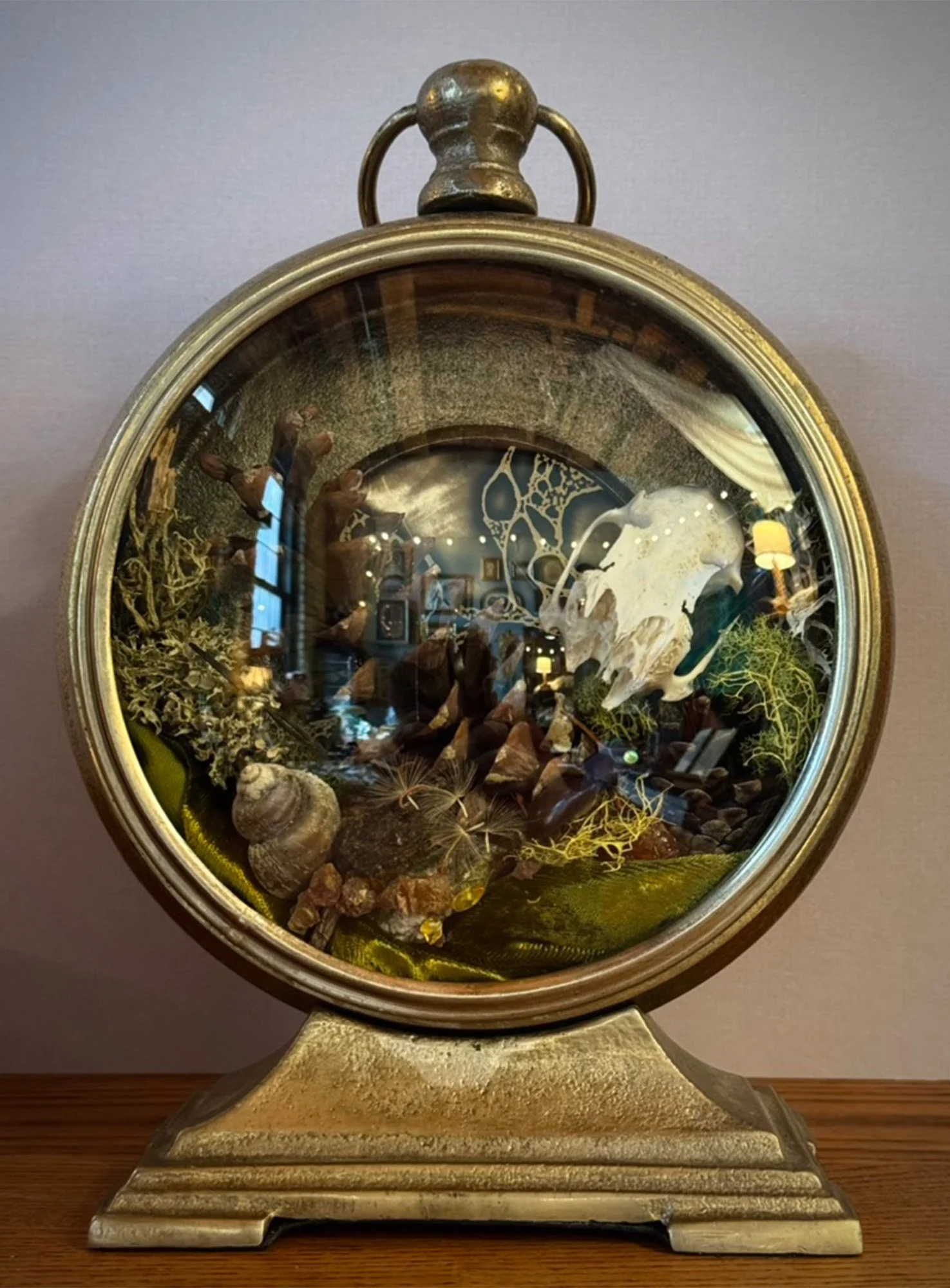
“Systems of Resilience: Time Unmeasured”, Ven Loetz, 2026 (Art piece made from an old clock)
At the end of a July morning spent chasing around between clinics, I found myself getting back into my hot car, much farther from home than I’d intended when I left and with bruises blossoming on both arms. The sky was sunny but hazy, an ominous tinge of orange and a scent of woodsmoke on the wind.
As I started back toward the freeway, I noticed a thrift store nearby and decided to stop in on a whim. I picked through old picture frames and jewelry boxes, deciding on a few odds and ends. As I stood in line to check out, I noticed an unusual clock on a shelf near the exit. It was solid metal with a lovely domed glass front. I picked it up. It was heavy. The price tag on the bottom said $3.99. As I was called to the register, I put it in my cart.
That afternoon, back at my art studio, I put a battery in the back compartment but found the clock mechanism no longer worked. I felt strongly compelled to take the whole thing apart. So much so that I sadly neglected to take a photo of it before I started. The hole in the back of the clock was only a few inches in diameter, and it made removing the mechanism and clock face a serious challenge. I put on a video lecture for one of my summer classes in the background as I grabbed pliers and other tools. It turned out the clock face was made of printed paper glued to a thick piece of tin. I spent more than an hour maneuvering a wire cutter in through that back hole snipping and pulling and bending, snipping and pulling, extracting one mangled piece of tin at a time.
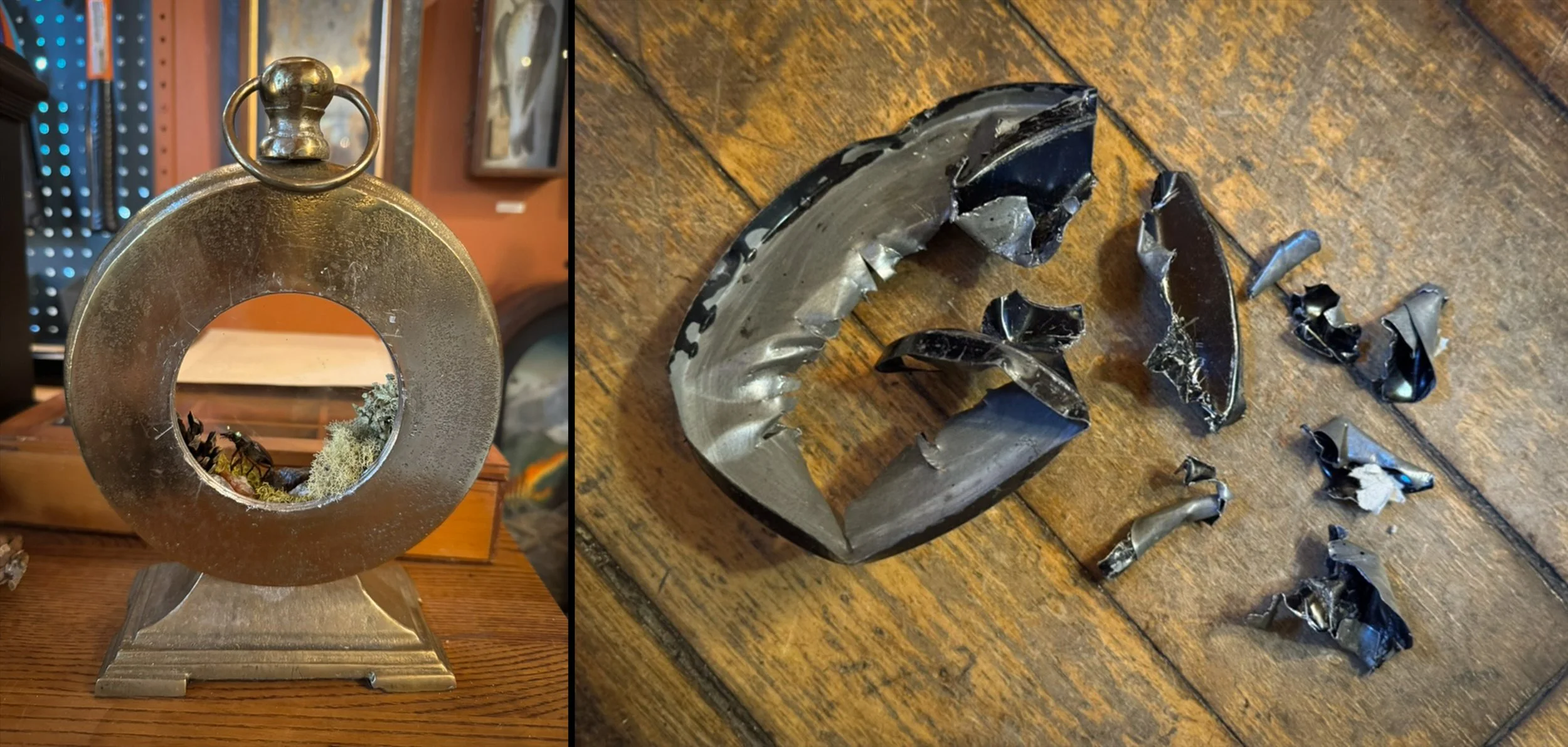
Back of the gutted clock (Left) and remains of the tin disk (Right)
I had to be very forceful and aggressive to remove that tin disk, but at the same time, I didn’t want to break the lovely bubble glass on the front of the clock or cut myself on the shreds of tin. So I had to hold it gently with one hand and use necessary force with the other. It allowed me to hold both the anger and gratitude I felt, both the frustration and the safety of the system I had repeatedly submitted myself to. All the while, the light coming in through my windows got hazier and more orange. The woodsmoke scent grew stronger.
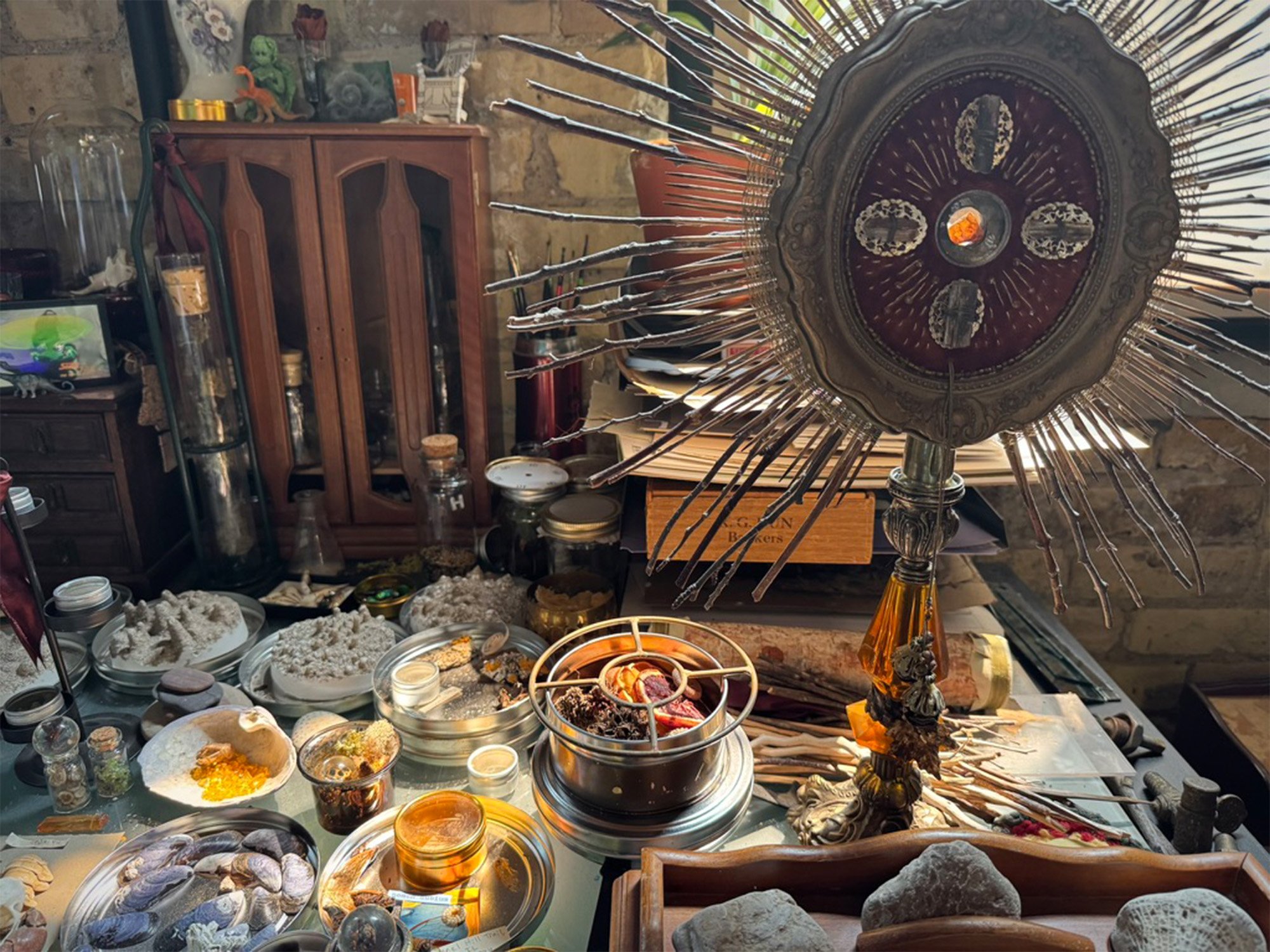
Strange orange light entering my art studio
As I finished pulling the guts out of the clock, I realized the video lecture had ended. I also realized I couldn’t remember any of it and started it over. I carefully cleared the debris inside the empty clock casing and used a soft cloth to clean the curved glass. I began to fetch items around my studio to put inside; a scrap of green velvet, a pinecone that only opens in the heat of forest fires, a rabbit skull I’d found in our yard on Mother’s Day.
As I played around with tweezers carefully arranging the contents, my phone buzzed. I set down my project to find text messages from relatives “up north”. The First Nations community around Whitewater Lake had been evacuated as had a newer fishing lodge on the lake’s shore. Wildfires were raging through Wabakimi Provincial Park.
I took everything out of the clock and dug through my collections of natural objects looking for one thing in particular: a snail shell. Then I put all the items back inside the clock along with a staghorn beetle and some fossil amber. Amber always reminds me of my favorite research island: Jurassic Park. Last, I re-inserted the hands of the clock, at odd angles, one aligning with the snail shell and one protruding through the eye socket of the rabbit skull. I photographed it and sent it to the family text thread. We all shared our sadness at the possible loss of Wendell’s cabins. Would the surrounding lake water protect the island? Would the island’s natural perimeter be enough to spare it?
Someone shared a video taken by a fisherman on the lake, showing a massive inferno and smoke plumes climbing high into the sky. It certainly didn’t give much room for hope; a moment of beauty and terror. As I sealed the back of the clock, I thought to myself, “I have ritually un-measured time. I reclaim this day in the name of The Snail.”
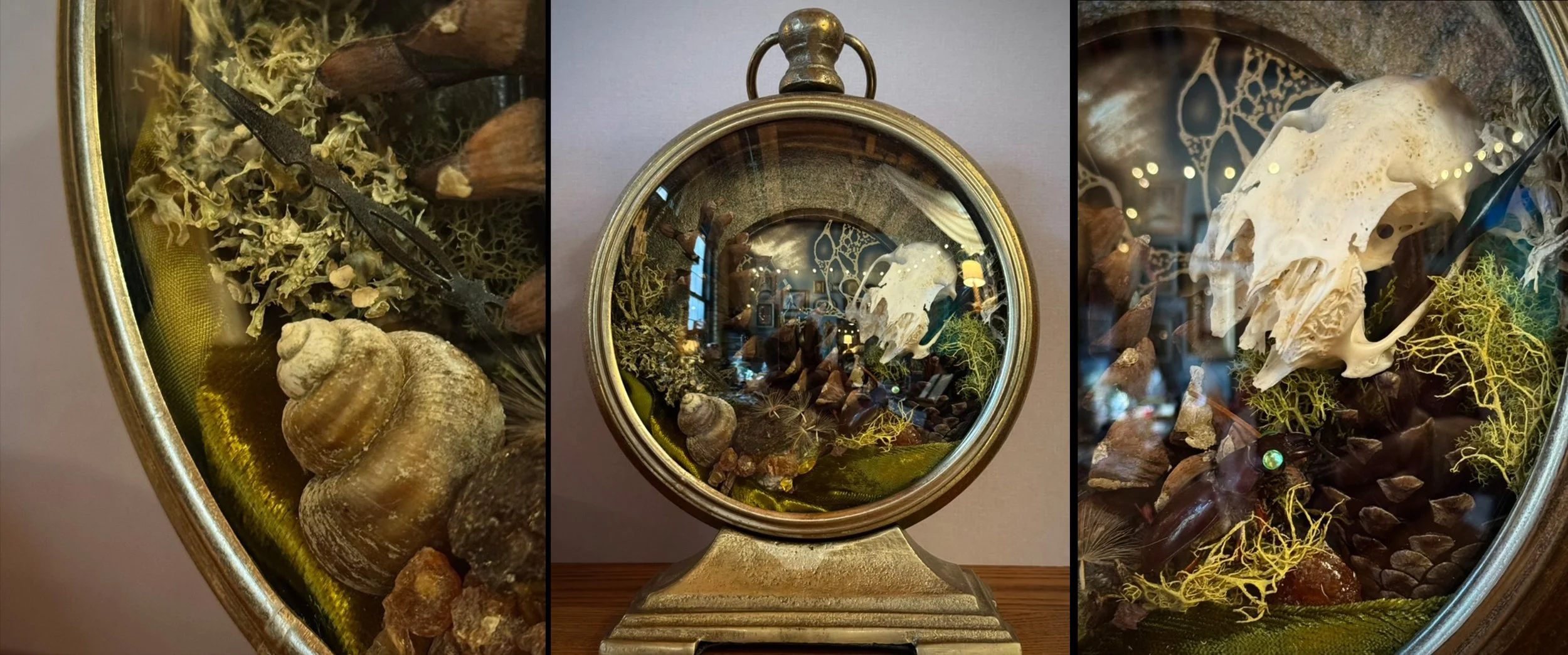
Finished art piece and details “Systems of Resilience: Time Unmeasured”, Ven Loetz, 2026
Looking back at Wendell’s journey through the spiral of time, I think about how he started. He wanted to do pure research, and Harry Wirth was able to fund him. Harry wanted exclusive access to true, rugged wilderness for himself and his friends and apparently saw Wendell’s ingenuity and willingness as a means to that end. As Harry returned to the island over the years, he became very put out at the presence of Outward Bound students and National Geographic. He had paid for an exclusive island retreat and now it was open to anyone who could canoe there. Perhaps in his mind he wasn’t getting what he’d paid for. This resulted in arguments and eventually the dissolution of their partnership.
The funny part (to me anyway) is that neither of them owned or had any claim to the land they were building on. While the Canadian government eventually gave Wendell a land use permit, Wendell and Harry had started their partnership as a typical business transaction on land that neither of them had paid for or even had permission to use.
What ended up happening though, is something more interesting. Just by being there and doing his own work, community found him. Initially, Harry had contracted the First Nations people to help with the building projects and to make crafts to be displayed in the retreat cabin. But over the years, they paddled out to the island to check in with Wendell, teaching him much needed survival skills. He graciously accepted their help and companionship, returned the favors when needed, and shared what he was working on. Outward Bound came to him for educational experiences and he happily obliged, and they brought him provisions and helped with repairs in return. Rose learned skills in management, woodworking, data collection and had years of unforgettable experiences. She ended up meeting the love of her life in transit to and from the island. Rose and the pilot husband, Allan Minar, continued to supply Wendell even after their mutual friend Harry cut ties.
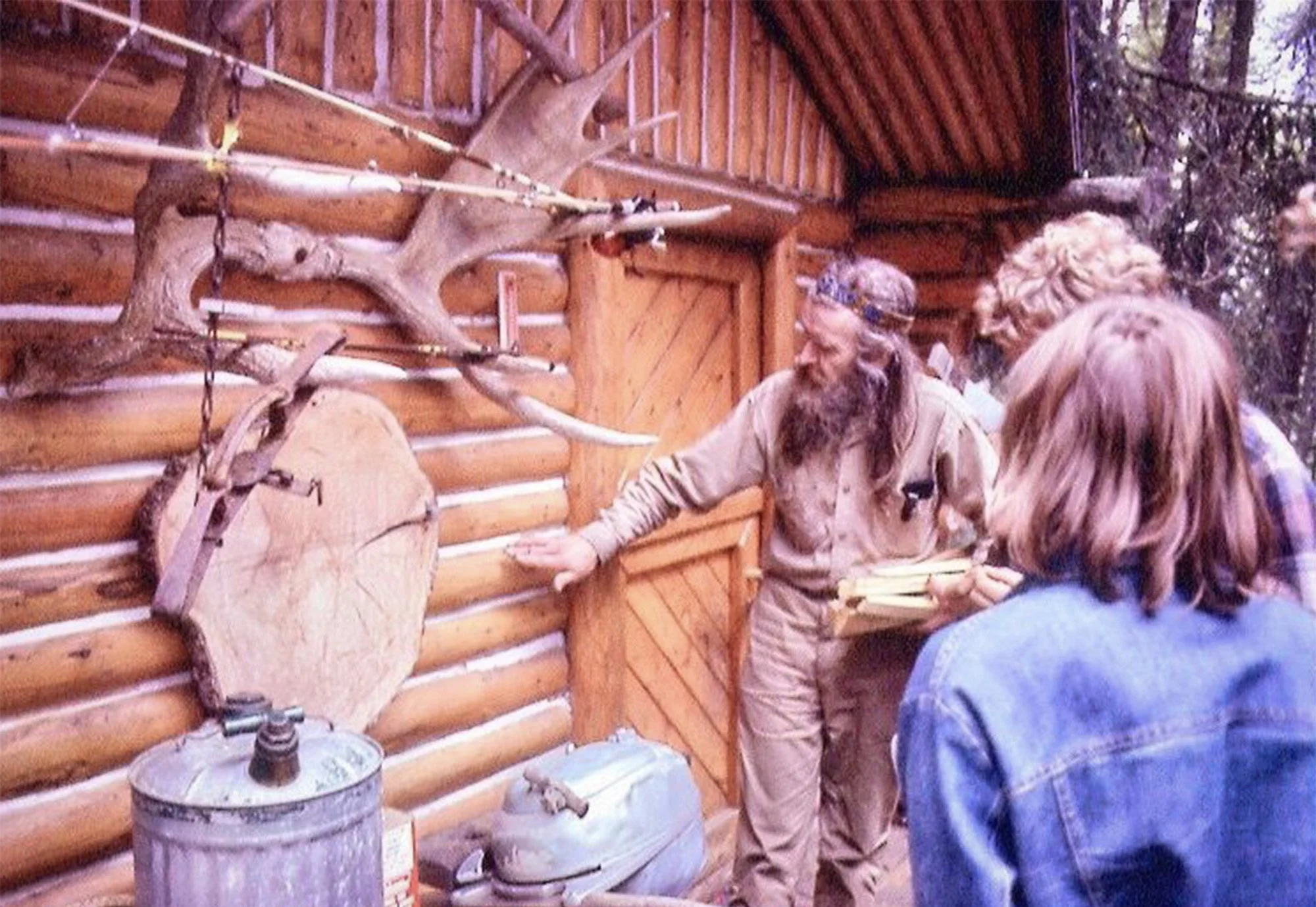
Wendell sharing his creations with visiting students, Thunder Bay Museum
Wendell never had to share his work on Substack begging for paid subscribers or stream his cabin-building progress on YouTube for ad revenue. Even after his death, he never became truly famous. He remains a niche folk figure in the region and a beloved family legend to those who survive him.
The Canadian government eventually saw value in his work and cultural significance, signing an agreement to take possession of his findings after his death. Despite the fact that it’s unknown if he ever made any significant scientific discoveries, Thunder Bay Museum holds many of his hand-made objects and all of his research notes and they helped fund a documentary about him. Even the filmmaker was someone who’d met him decades ago on the island and made the film as a longtime personal dream.
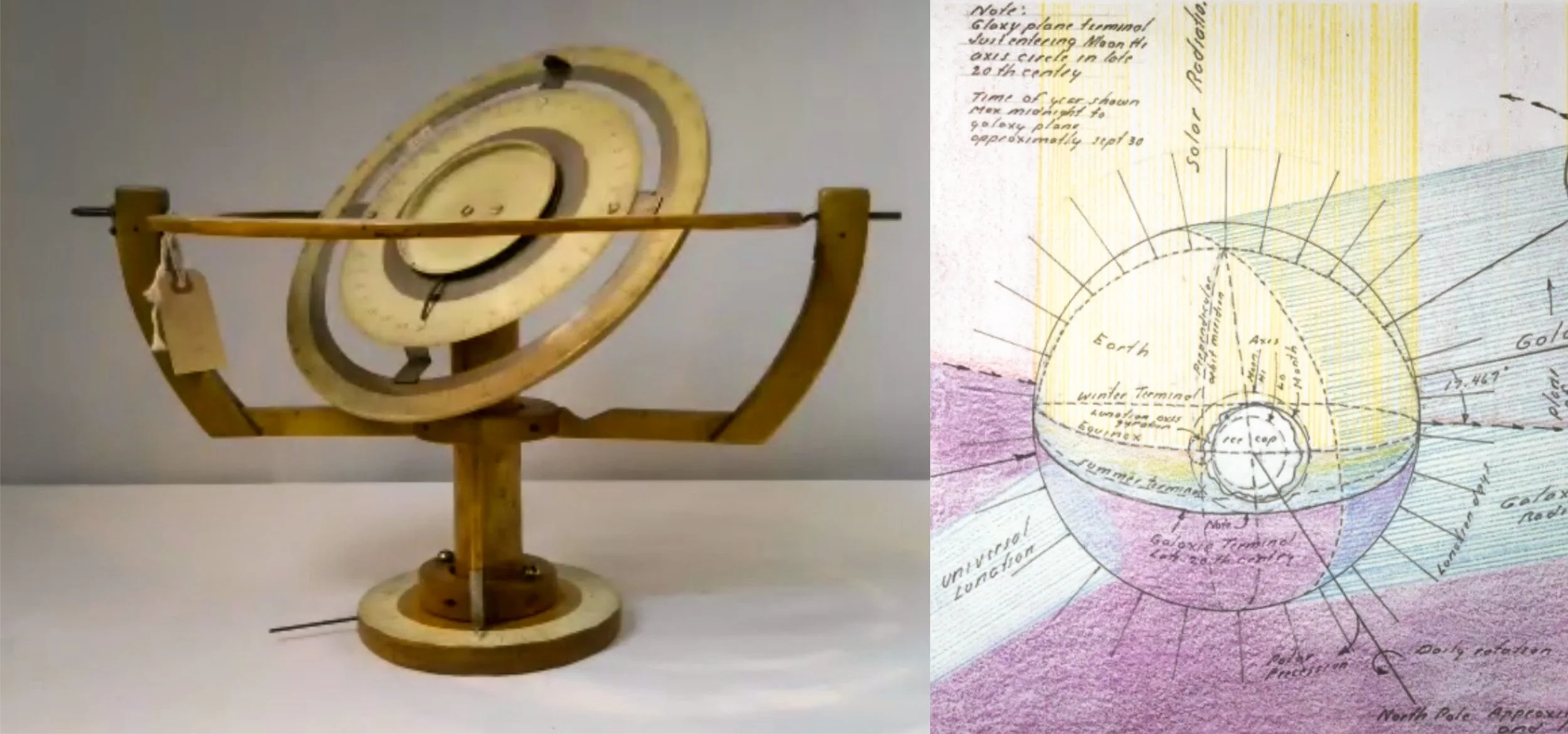
Homemade astronomical device (Left) and illustration by Wendell showing his theories of the universe (Right) both at Thunder Bay Museum
The very first time I’d heard of Wendell was in the late 1990’s when my then-boyfriend casually mentioned “My great-uncle invented the ballpoint pen” while hanging out after school. As it turns out, Wendell did not invent the ballpoint pen. Nobody single-handedly did. Like every other thing about him, this larger-than-life claim gives way to a deeper reality of complex relationships and complicated backstories. The truth is less bombastic, but actually more interesting in its details; Wendell’s patents were crucial innovations out of the many, many incremental developments along the way that made the ballpoint pen a practical and scalable writing instrument. He had the mind of a true tinkerer and apparently loved a good challenge from the microscopic divots in the pen’s tiny ball to the chemistry of the ink that would flow smoothly through it.
If the allure of the secret research island is in its isolation and exclusivity, the pursuit of hyper-masculine control of nature, and escape from accountability, Best Island ultimately meets none of these criteria. The heroic individualist narrative of Wendell Beckwith that seems true on the surface collapses with any amount of scrutiny into something more tender and nuanced; a person who acted as a conduit and resonator of deeply embodied knowledge within a larger shared body of knowledge. Harry Wirth apparently wanted to buy the wild unknown, Wendell cultivated a relationship with it.
As of this writing, we still don’t know the fate of Wendell’s cabins on Best Island. Communications with family have included videos, satellite images, reports from the fishing lodge. But ultimately, no one will know what remains until someone takes a boat or sea plane out for a closer look. For the time being, it remains suspended in a probabilistic state: Schrödinger’s Snail.
It wasn’t until after the whole art piece was finished that I noticed the design on the discarded paper clock face was an arrangement of spiraling shells. I had ripped apart time so hastily that I’d missed the repeating pattern; time taken from the Snail is time returned at the next turn of the spiral.
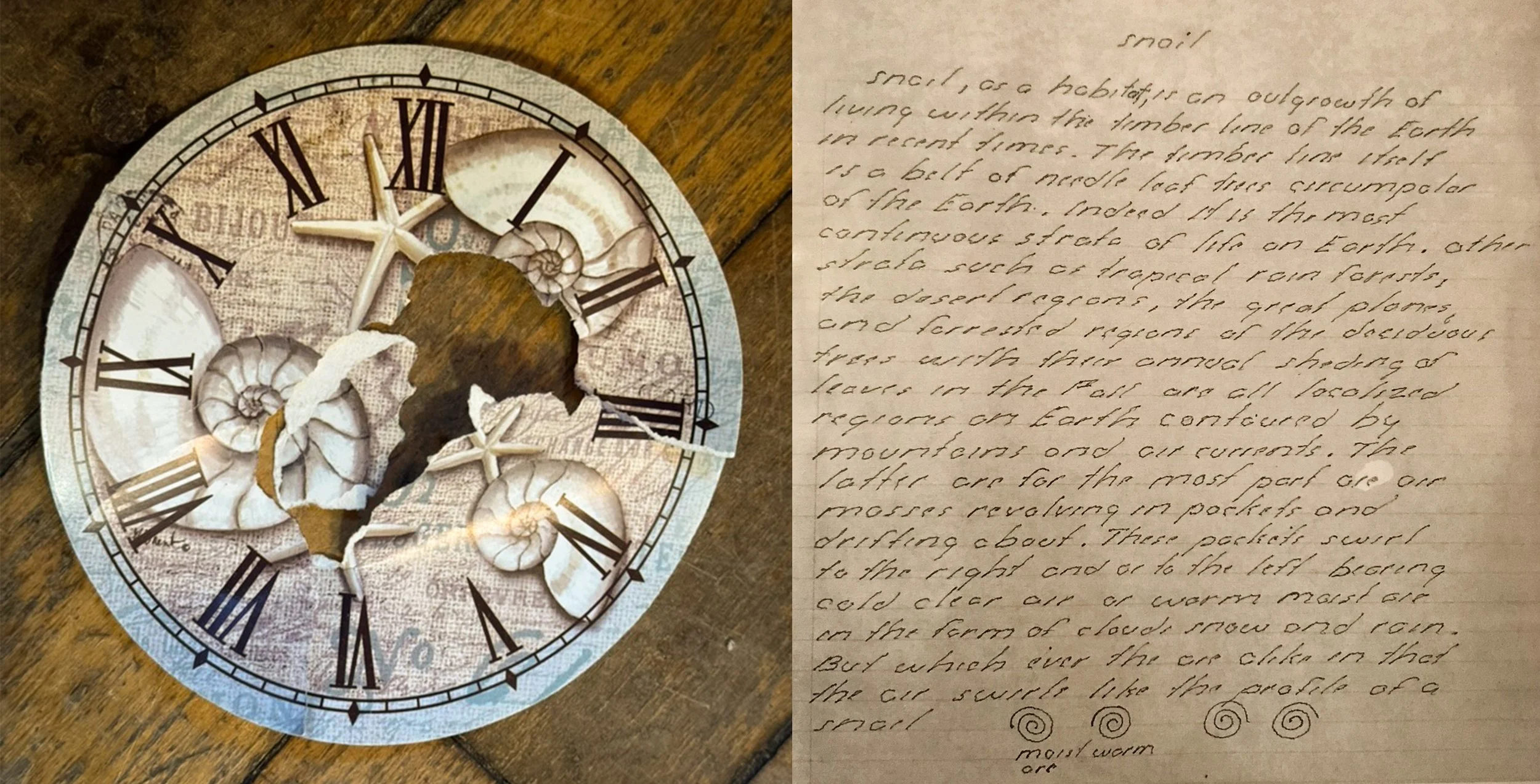
The torn paper clockface I removed from the thrift store clock (Left) A handwritten musing about the Snail and swirling air currents by Wendell (Right) photo by Mike Lawton
“When I was in an applied science field I never thought that way, because you were preoccupied with a goal and as I say, from time to time you’d run into those things but you’d never have time to work with ‘em. You’d just have to shove ‘em off, get rid of ‘em, and go to work. So that was the first thing was to get out of that situation so when they did appear you could work with them and that meant you had to divorce yourself completely from the clock-like precision of life in society and get into a situation where your requirements for living were so simple they could be accomplished in short order.” – Wendell Beckwith, spoken recording used in “In Search of Wendell Beckwith”