Systems of Resilience Part I: Wendell’s Snail
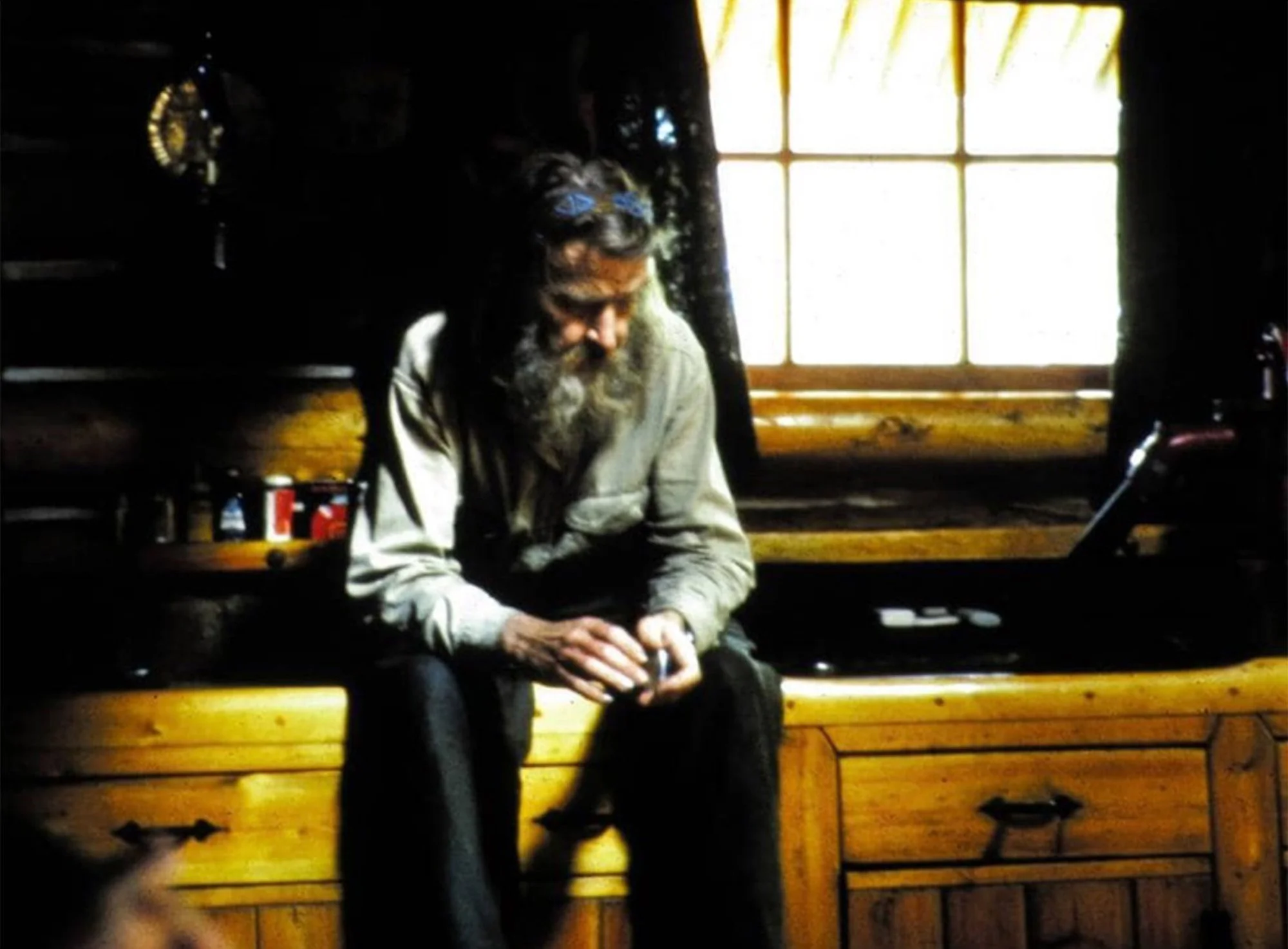
Wendell King Beckwith in the kitchen of one of his cabins on Best Island, photo Thunder Bay Museum
One of my favorite science fiction tropes is the “secret research island”. From the Island of Dr. Moreau to Lost to the recent Alien Earth series, there are any number of examples of scientists choosing a remote island to do their research unencumbered by the ethical oversight of institutional review boards or the peer review process. Of course, as a dinosaur enthusiast, my favorite research-island-gone-wrong is Jurassic Park. (The scientists were so busy figuring out if theycould they didn’t stop to think if they should). Beyond the realm of science fiction, the trope extends to Bond villains, murder mysteries, and the real-life luxury island bunkers of wealthy elites.
What is the fascination with islands and are they really the best place to escape accountability? In an episode of Window’s Bay a character radios the sheriff asking him to establish a perimeter and the sheriff replies “The island has a perimeter. It’s called the ocean.” Perhaps that hard boundary and isolation are what drives the narrative; the containment within which constraints are released.
The allure of a secret research island is undeniable, but are they really doomed to go terribly wrong? Let’s consider one that didn’t turn evil: Best Island in Whitewater Lake, Ontario.
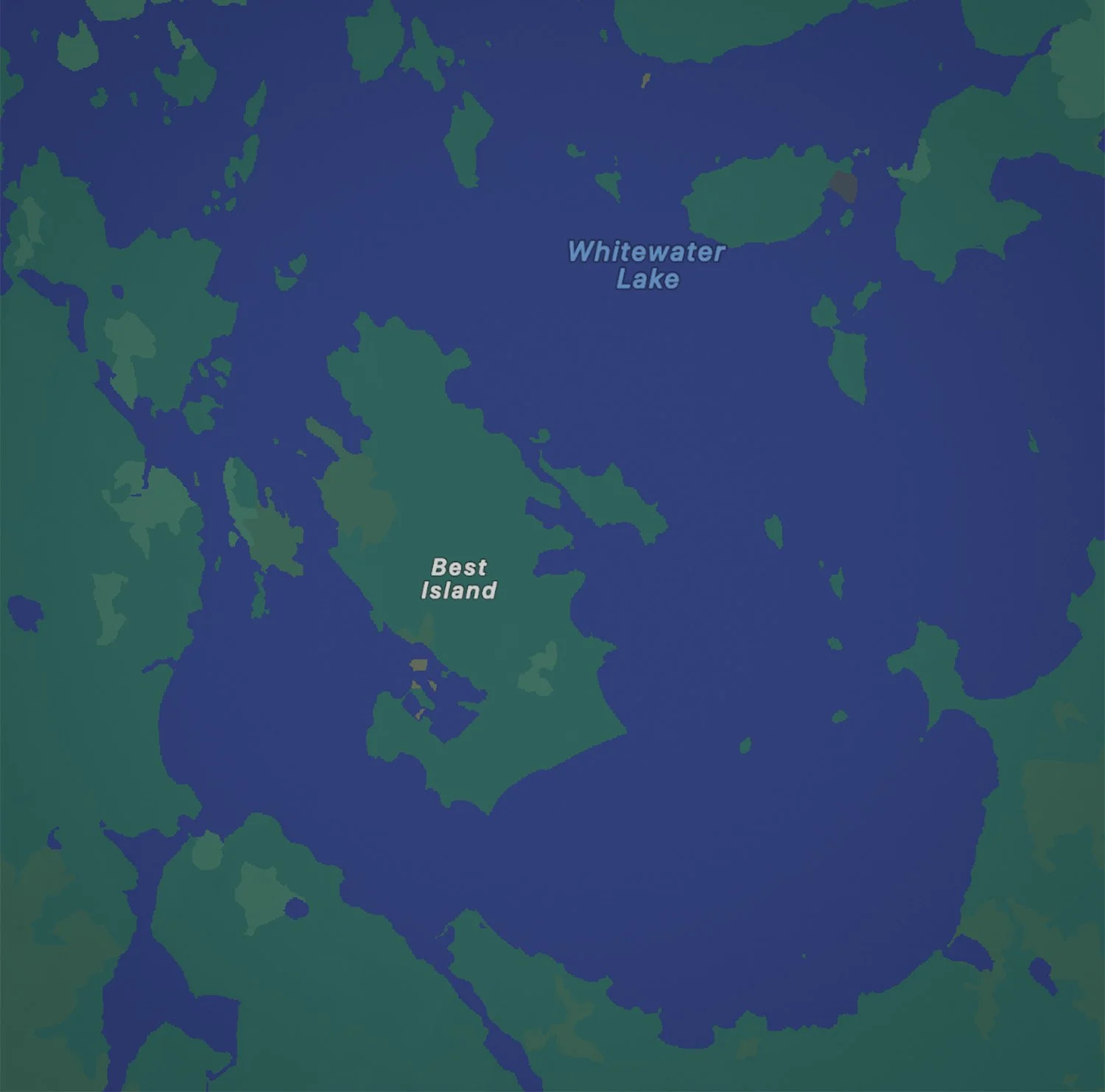
I have spent roughly 30 years hearing tales of Uncle Wendell and his cabins. A relative of mine by marriage, Wendell Beckwith (1915-1980) was an eccentric inventor and self-taught engineer who held patents for the ballpoint pen. He worked as chief engineer at Milwaukee Tool Company for a time where he met his wife Betty, also an unusual character, who served as his executive secretary. They had five children. But in 1961, he left behind his career and family in Wisconsin and moved to a remote island in the middle of a lake in Ontario, Canada. The area would later become Wabakimi Provencial Park and was (and still is) rugged wilderness only accessible by sea plane or a multi-day canoe excursion. Why did he set out for this remote location? Why didn’t he seek legal entry into Canada? Because he wanted to do what he referred to as “pure research”.
He had a wealthy benefactor named Harry Wirth who funded him with the expectation that Wendell would turn the island into some sort of remote wilderness retreat. Perhaps not a “luxury bunker”, but more like a 1960’s bro lodge (my interpretation). His first years on the island he built a large cabin for this purpose, but the longer he was there the less interested he seemingly became with the businessman-retreat concept.
He constructed scientific instruments for measuring various phenomena, took notes on the positions of stars and planets, the sun and moon. He recorded weather data and sat down daily with blank sheets of paper and just wrote and wrote. He was obsessed with the number pi and the Fibonacci spiral that came up over and over again in nature. Some of his theories revolved around gravitation, human migration, and energy lines. He seemingly believed the earth’s magnetic poles were about to reverse and that Best Island was the ideal place to survive such an event. With only a 1930’s high school education, his self-taught research style resembled that of an outsider artist but for science; let’s call him an outsider scientist and folk engineer. Stacks of his writings and drawings are housed at a museum in Thunder Bay, Ontario along with some of his hand-made devices and wood carvings. Unfortunately, Wendell’s invented calendar dating system complicates interpretations of his data.
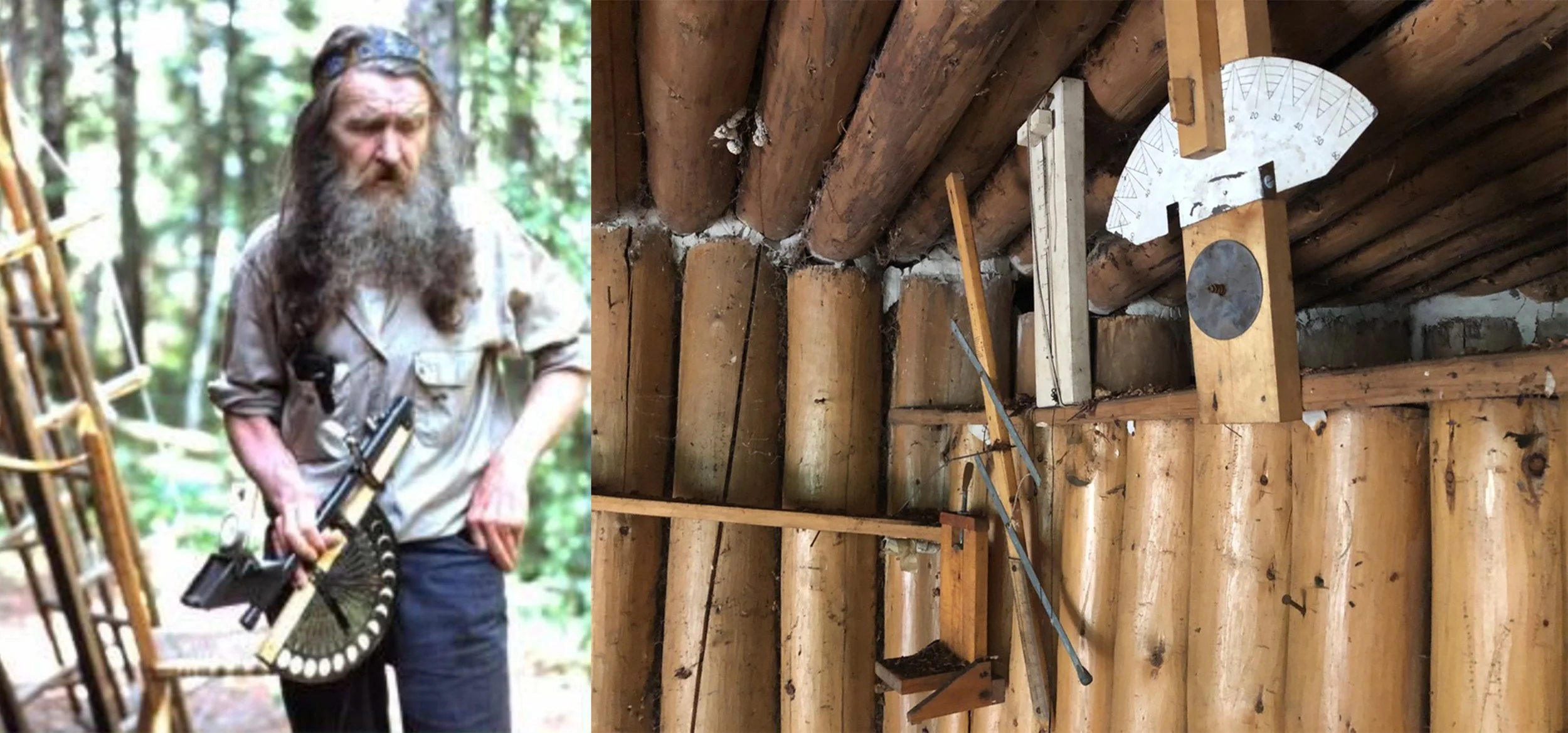
Wendell holding an astronomical device he called a “Lunar Gun” (left), Handmade scientific instruments still hanging in one of his cabins as of July 2018, (right) photo by Chuck Lawton
His greatest creation was arguably a cabin he named “The Snail”. An interpretation of the Fibonacci spiral, it was built into a hill and spiraled inward. It had a skylight at the center and stone slabs in the floor that radiated heat from a central wood stove. While not showy or large, it was unique, efficient to heat, and blended into its surroundings.
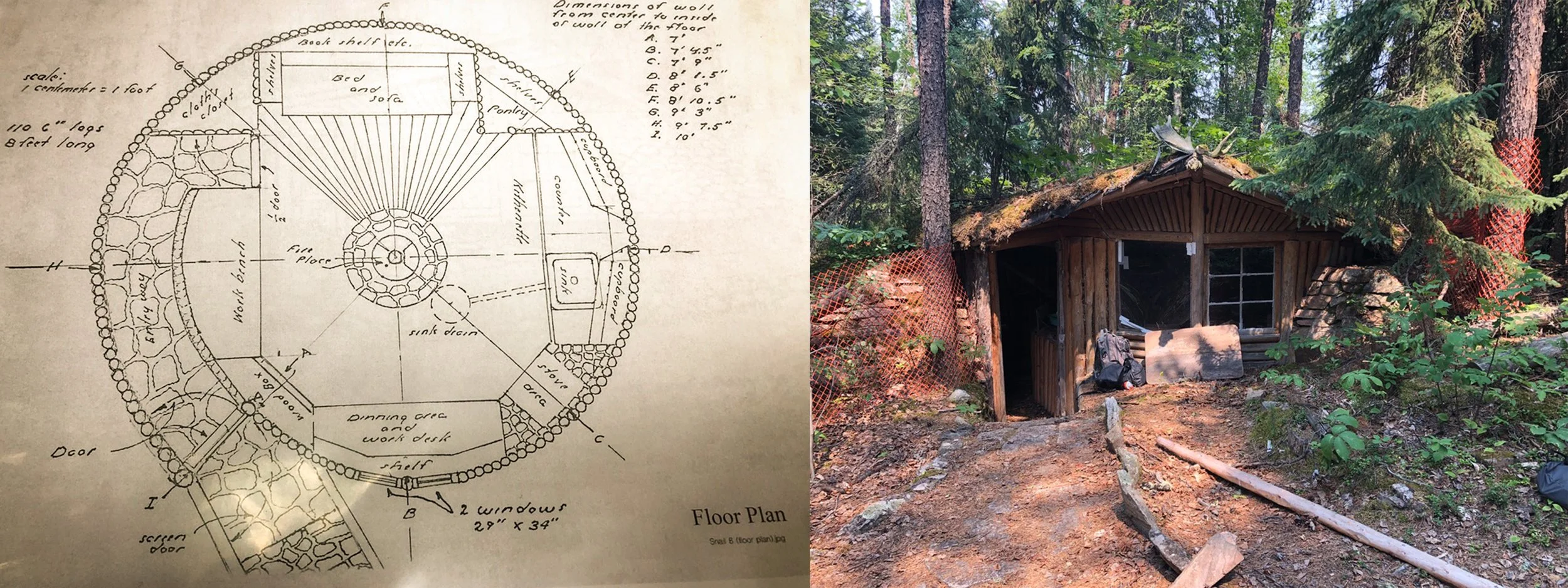
Wendell’s floor plan for “The Snail” (Left) Exterior of The Snail in July 2018 (Right) photo by Chuck Lawton
Wendell didn’t necessarily establish a secret research island to escape ethical constraints or peer review; he did it with the intent of fully inhabiting his research. He didn’t separate himself as an objective observer but instead immersed himself within a subjective experience. He cultivated a richly entangled relationship with his research and adapted his approaches to the demands of the island. He lived within the island, the larger system of the lake and reportedly got along well with his neighbors. He befriended but did not impose himself on the First Nations community on the lake’s shore. The documentary fully explores his relationship with them through interviews with Ruby Slipperjack who has many fond memories of Wendell from her childhood.
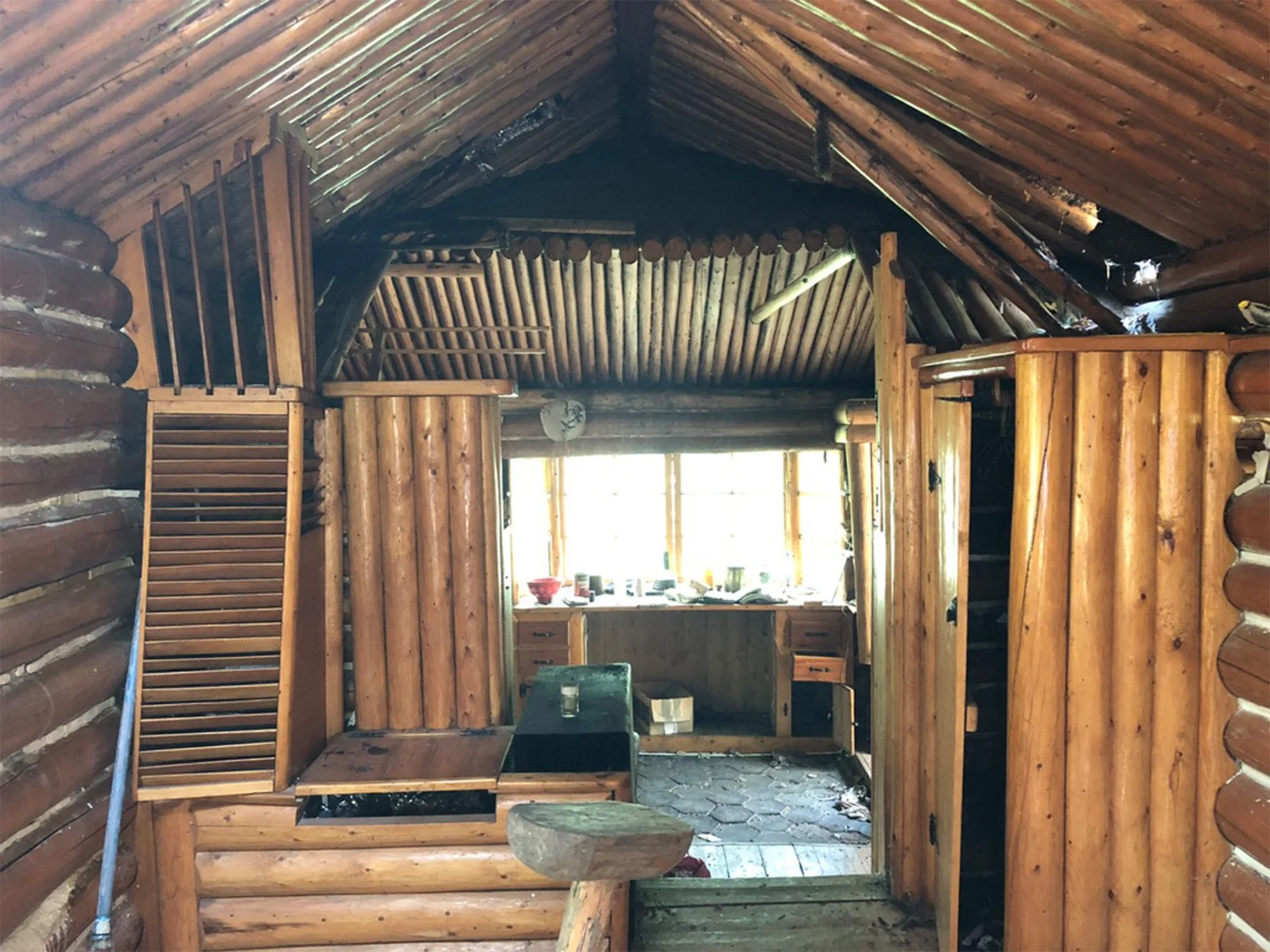
Interior of Rose’s cabin which she helped build, photo by Chuck Lawton
While he has been referred to as a hermit, for part of his time there he was joined by a woman named Rose Chaltry. She had been Harry Wirth’s assistant but decided she wanted to try out living according to a “back-to-the-land” philosophy. She offered to help Wendell with many maintenance tasks and she helped to build her own cabin. She only stayed for one winter, but would return in future summers.
Wendell also welcomed groups of canoe campers, offering tours of his cabins and teaching about his ongoing research. The Canadian government eventually granted him legal status, though he never sought it as he considered himself a “citizen of the world”. National Geographic visited the island and ran a short piece about Wendell in a 1978 issue.
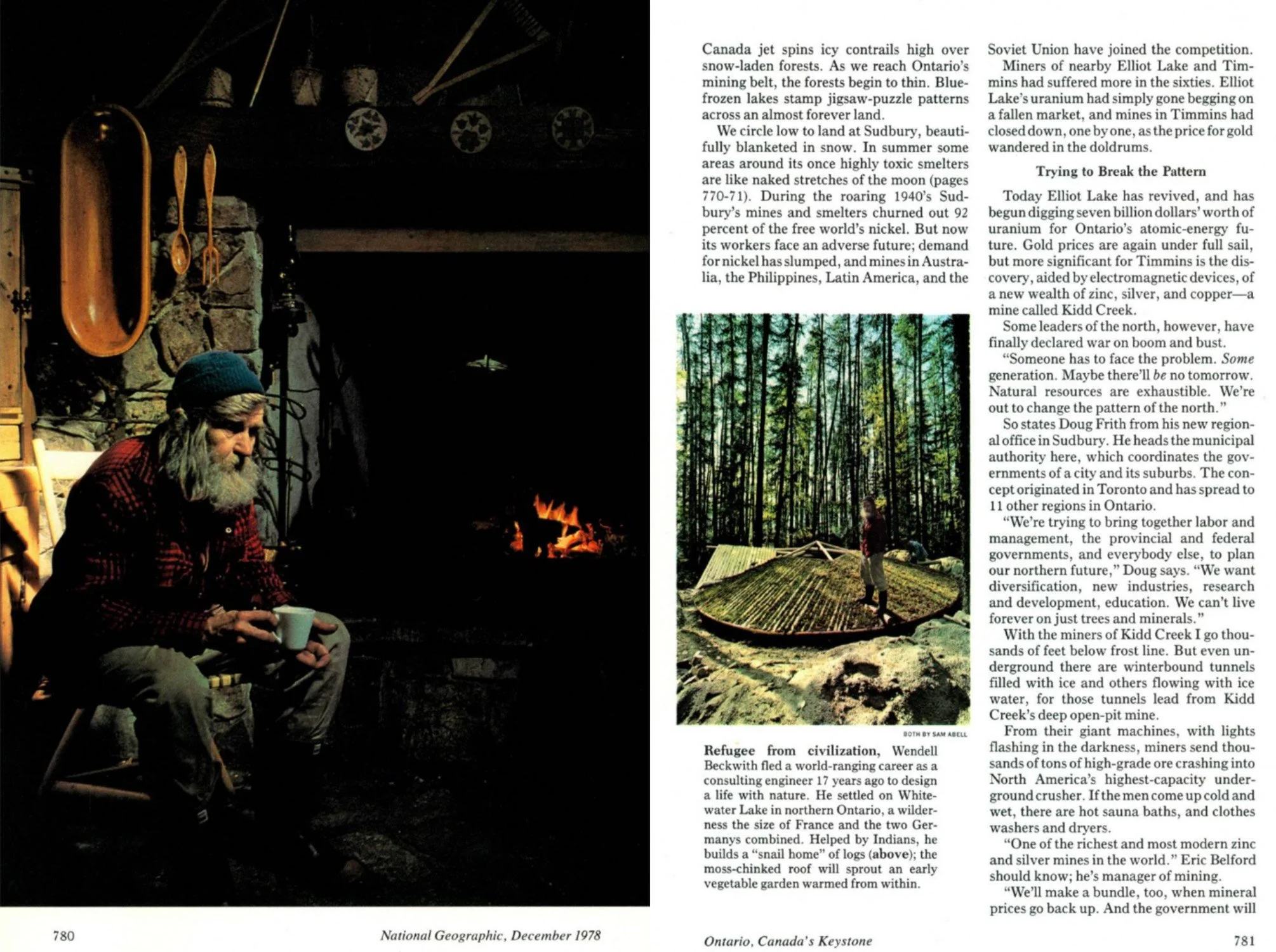
A photo of Wendell (Left) and the top of The Snail (Right) featured in National Geographic. The article mentions that he grew vegetables on the roof so the heat from the cabin helped them germinate, photos by Sam Abell.
For a hermit, he was apparently quite personable and enjoyed sharing his work with others. Though he envisioned other researchers coming to join him, perhaps each inhabiting their own snail, it was sadly not to be.
He died on the island in 1980 at the age of 64, suffering a heart attack on the beach and falling into the lake. The cabins have remained abandoned for more than four decades as nature slowly reclaims them.
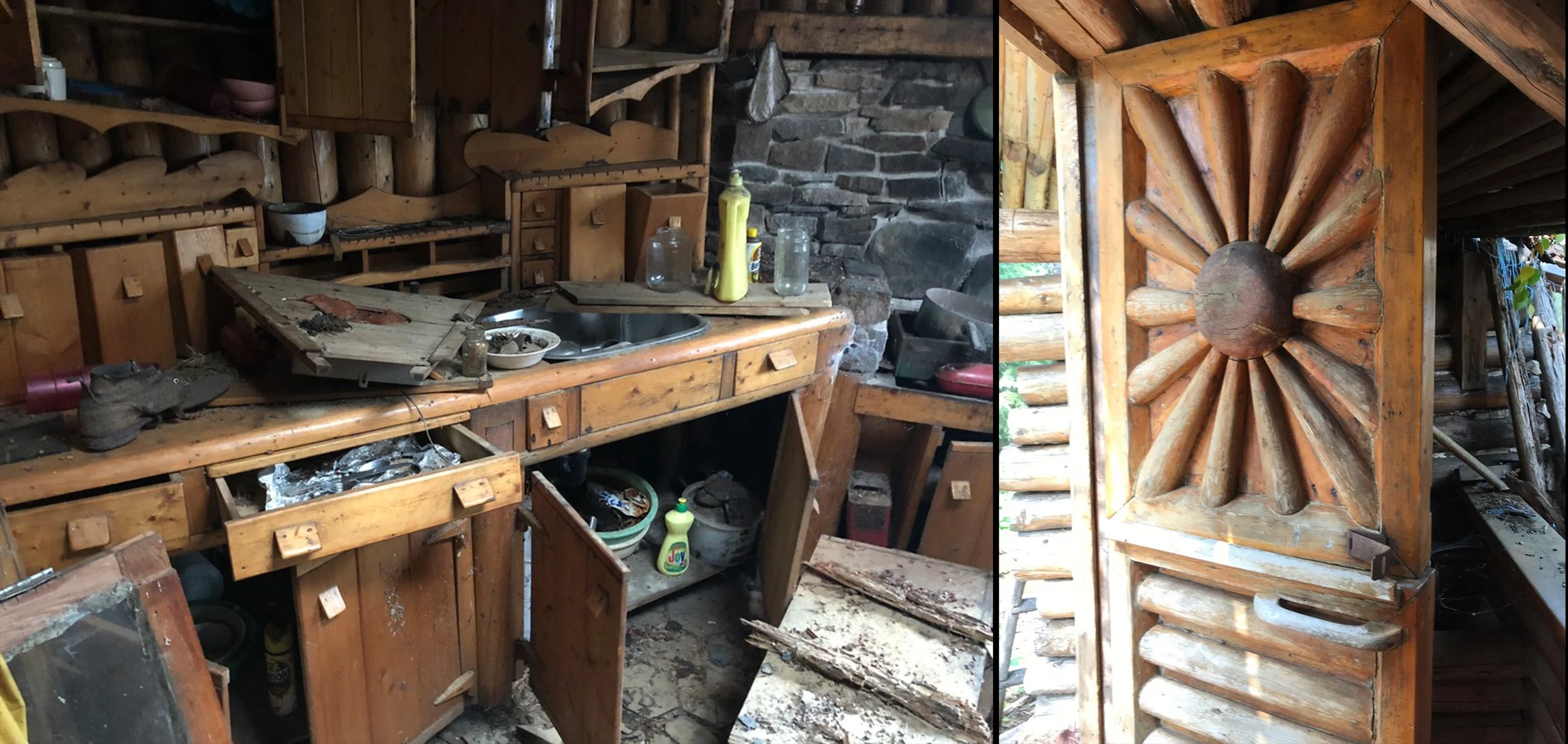
Interior of the large cabin he built initially as the “bro retreat” (Left) Detail of the cabin door (Right), in disrepair as of July 2018, photos by Chuck Lawton
In 2018, some of my family members had the opportunity to take a sea plane to Best Island and visit what remains of the cabins. I was not able to go with them and have regretted it. You can find their journey recounted on the Wilderness North website in an entry called “Retracing a Family Legacy”. A documentary called “In Search of Wendell Beckwith” was being filmed in partnership with Thunder Bay Museum while they were there and you can find it online. It conveys Wendell’s story in more depth and complexity than I’ve managed to in this telling. There are many wonderful interviews in the film along with photos he took and developed in a darkroom he made on the island.
Because I have never visited Best Island and Wendell is not someone I’ve ever met, he’s always been a bit larger than life and the family stories paint a picture of someone mysterious, intelligent, intuitive, and quiet. I can’t help but admire his commitment to living his research and becoming embedded in his studies. He viewed Best Island as the literal center of the universe and while his theories were as wild and eccentric as he was, the real experiment was seeing if he could live inside of them. This is less like reductive science and something more akin to a philosophical pursuit; a hermeneutical phenomenology of an island. The researcher and the universe shaped each other through the unfolding of time and shared context.
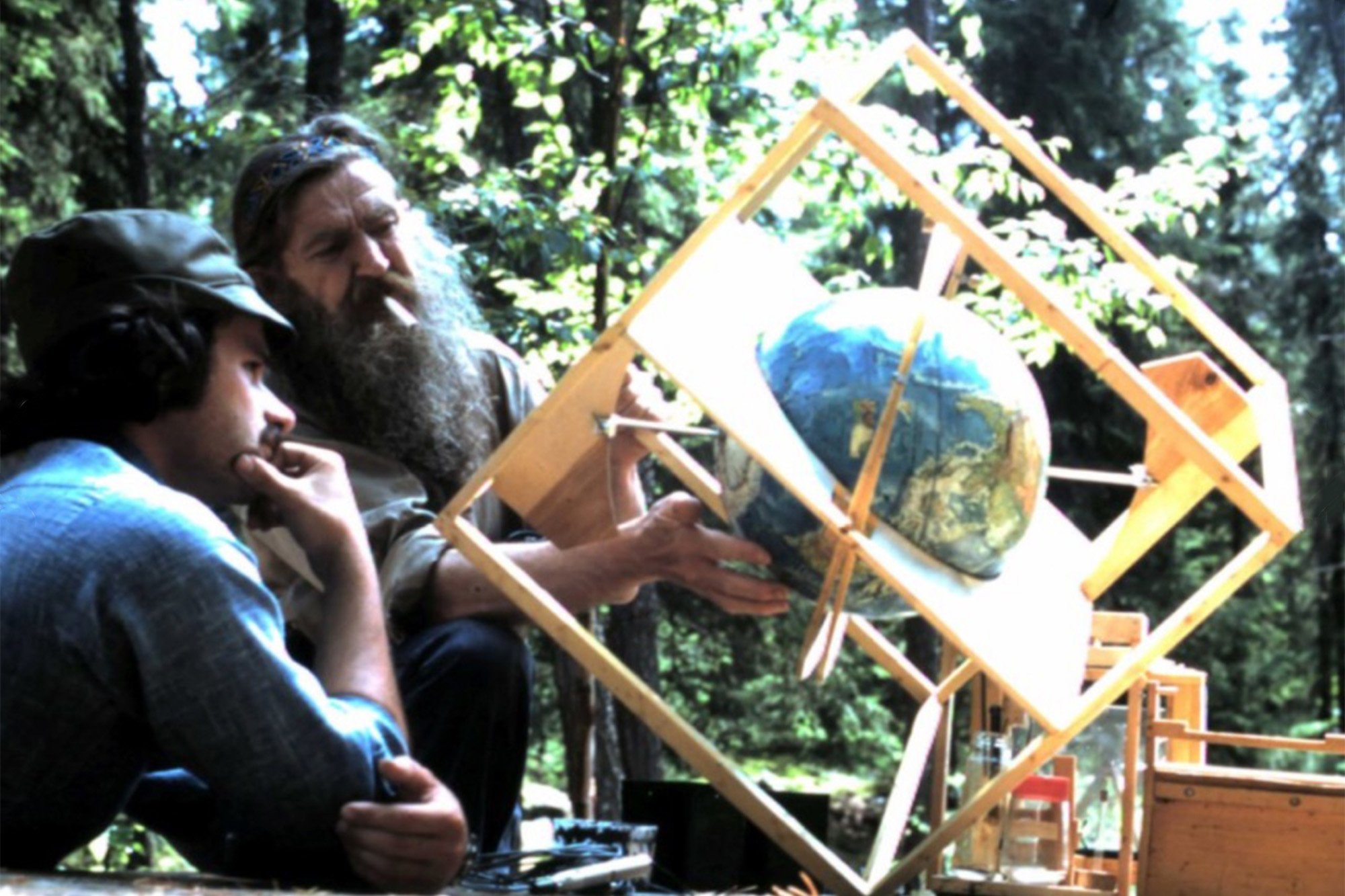
Wendell sharing his theories of the universe with a visitor, photo Thunder Bay Museum
He eschewed international borders, ignored the calendar year in favor of the natural seasons and astronomical timings, and managed to live outside of the economic framework he started out in. It’s worth mentioning though, that he didn’t do any of this alone. He used money from his time at Parker Pen Company and Milwaukee Tool to leave his wife and children with a trust, he started his journey with funding from Harry Wirth, and he graciously accepted assistance and advice from the First Nations tribes who periodically checked in on him. His friends at Outward Bound, an educational program, frequently brought students by canoe, continuing to visit him over the years and provision him and help out with repairs. After Wendell’s falling out with Wirth, Rose Chaltry (who eventually married a float plane pilot) continued to bring him supplies as well. While he did some fishing, foraging, and gardening, he also smoked a lot of cigarettes and ate a lot of Klik (Canadian Spam). Thus, the Hermit of Whitewater Lake survived through a web of natural supports and human relationships. No man, as it turns out, is an island.
My feelings about Wendell and the rambling, not-always-accurate tales I’ve heard over the years have shifted along with my own developmental course. When my kids were small, I thought of him as a selfish jerk who abandoned his family, though that doesn’t seem to be his surviving family’s assessment and I don’t feel that way now. Now I mostly marvel at his family and friends’ level of support, admiration, and continued insistence on telling and retelling his story. They seem to fully embrace and take pride in his oddness and unconventional achievements.
For myself as an artist and a voraciously curious thinker, the allure of this approach has caught me at times throughout adulthood. In moments of deep frustration, I get hit with a romantic longing for “pure research” wishing I could just drop everything, sneak into Canada and set up camp. My studio and hiking excursions are the closest thing I have. I sometimes try to imagine what it would be like to sleep inside the spiral of the Snail; waking to a world alive with birdsong, the susurrus of leaves, and a lake flashing with fish; woodsmoke curling up through the subterranean chimney mixed with the scent of damp earth and pine needles. There is more data here in just the imagining of it than could be accurately cataloged in a meter-high stack of scientific papers. It is a dream of fully embodied knowledge.